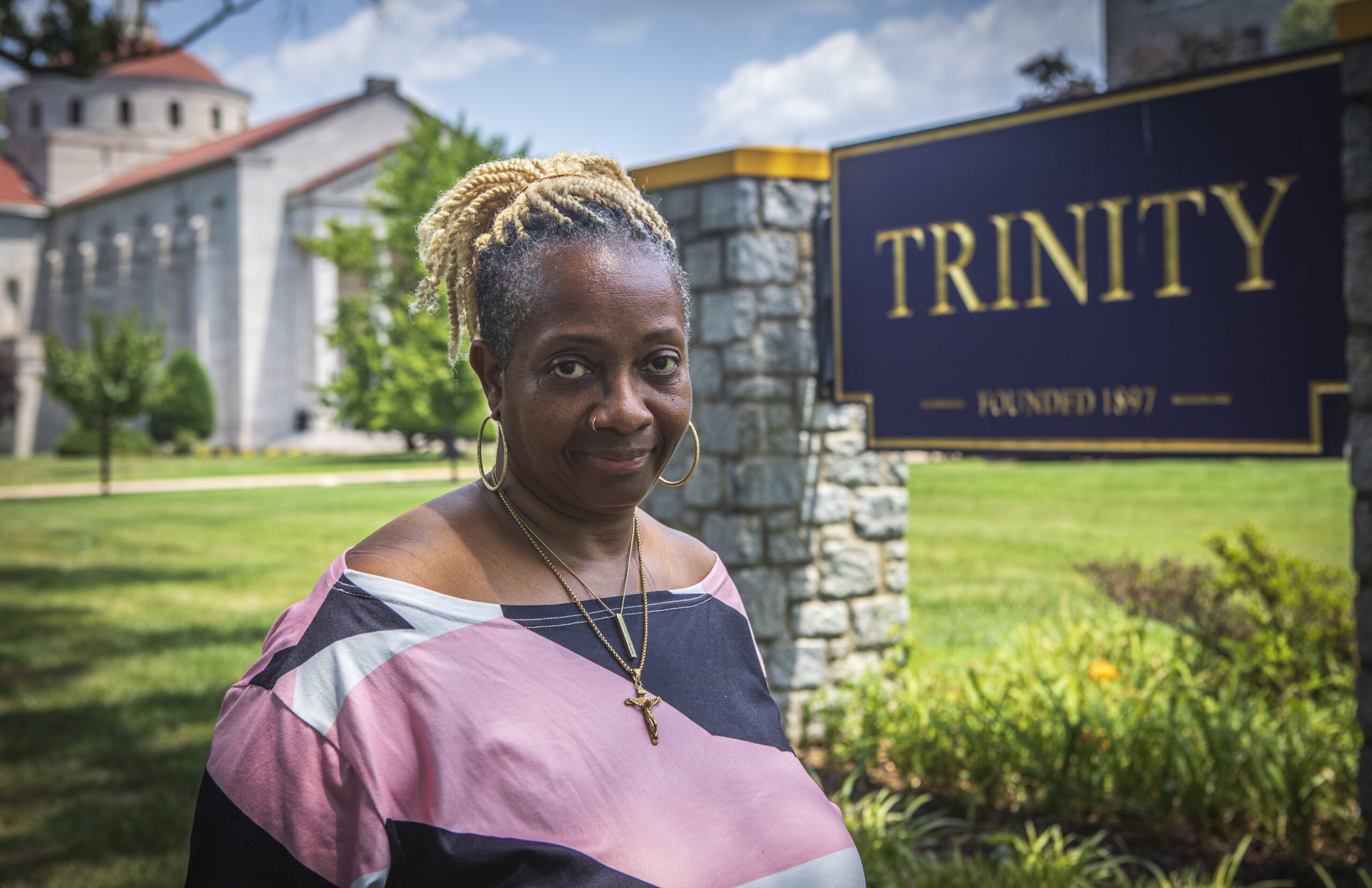
By Tonya O’Neal
Bachelor’s degree candidate, Trinity Washington University, Class of January 2027
I never imagined that at 57 years old I would be preparing for graduation, mentoring others in recovery and starting graduate school – but Trinity Washington University helped me believe that it is never too late.
For much of my life, I did not think I would make it this far. My story includes childhood trauma, addiction, depression, grief and years of searching for love, safety and peace in the wrong places. There were times I gave up on myself completely. But through recovery, faith, motherhood and the support I found at Trinity, I slowly began rebuilding my life. This journey to graduation is about more than earning a degree. It is about healing, breaking generational cycles and finally believing that my past does not have to determine my future.
I am a native Washingtonian, born and raised in the Ledroit Park neighborhood of Washington, D.C. I am 57 years old and spent much of my childhood attending Mount Bethel Baptist Church in the Bloomingdale neighborhood. I grew up in a crowded family home with my mother, brother, sister, uncle, grandmother, cousins and nephews. I am the youngest of three siblings, with 10 and 21 years between us. My mother was 16 years old when she had her first child. She had only a ninth-grade education, and my dear grandmother had only a third-grade education after being pulled out of school to care for her siblings. Despite that, my grandmother taught herself to read and write.
My siblings and I each had different fathers. My brother’s father was never around, and I was my father’s only child. Although my parents never married, and I remember feeling protected, secure and loved. We were not wealthy, but as children we hardly noticed because everyone contributed what they could to make sure we had joyful holidays and a sense of family. My nephews and I were close in age and grew up more like brothers and sisters than my actual brother and sister. We spent our days running through the alleys and around the block, knowing we had to be home before the street lights came on. But I also grew up in a time when family secrets stayed inside the house. Beneath the love and togetherness were struggles with domestic violence, alcoholism and drug abuse.
My mother brought someone into our household whose presence changed the course of our lives in devastating ways, especially for the girls growing up in that home. What followed was a long period I now understand as shaped by silence, secrecy, and unspoken harm. Children were expected to be seen and not heard, yet we absorbed far more than we were ever meant to carry.
Over time, our family life came to include teen pregnancy and accusations of sexual abuse, which I also experienced. Those experiences, and the silence surrounding them, became part of the private burden of our household – stories that were never fully spoken, but always present.
Two weeks before my 13th birthday, my father died at the age of 42. He struggled with alcohol, though he was what people often described as a functional alcoholic – he held a job, owned a home in Maryland, and was married. I had lived with him for about a year before his death. My father was a country boy, my mother a city girl. When he died, I felt completely lost and could not understand why God had taken him. I knew he loved me, and I felt safe with him.
After his death, I fell into a deep grief and attempted to follow him in death, which led to my hospitalization at St. Elizabeths Hospital. When I was released, I began spending more time outside the home, meeting new people, and trying new things. I started using drugs, which sometimes dulled the pain, but only temporarily.
By age 16, I had been hospitalized twice at the Psychiatric Institute of Washington – first at 14 and again at 16 – due to substance use and depression.
My drug use continued, and with it came increased vulnerability and exploitation. I was looking for a father figure and stability but instead found myself surrounded by older individuals who took advantage of that need. I began trying to survive on my own and eventually became involved in situations I now understand as exploitation tied to my addiction and instability.
My drug of choice was cocaine, though I also used marijuana, PCP, and LSD. The substance use continued for decades. I was first introduced to a 12-step program at 14 and went in and out of recovery over the years.
Alongside ongoing substance use came experiences of domestic violence and sexual victimization. At 14, I was taken to Fayetteville, North Carolina, by a male friend of my sister’s, where I was later abandoned. I was away from home for about a month. During that time, I was exposed to unsafe situations and exploitation – including prostitution, until I was eventually able to contact my mother, who sent money for a bus ticket so I could return to Washington, D.C.
Despite having a home to return to, I continued to run from grief and pain, searching for love, safety, and belonging in ways that often led me into harm.
My mother did the best she could with what she had, but she also struggled with a strong focus on money and survival. During my early teenage years, there were moments when she knew I was involved in situations with older men, and she accepted money I brought home. Looking back, I understand that period very differently than I did at the time.
Between the ages of 13 and 18, I spent time with a group of girls who also felt grown up long before we were. We skipped school, used drugs, and went out to clubs that played D.C.’s signature go-go music. There were many experiences during that time I don’t fully go into here, but they reflect a period of instability and poor decision-making shaped by our environment.
Academically, I struggled to stay engaged in school – not because I lacked ability, but because I stopped attending regularly. I left high school in the 10th grade at 15.
By 2011, the consequences of the life I had been living had caught up with me. I spent several months incarcerated following a misdemeanor assault charge and a probation violation. It was another moment that forced me to confront the pain, addiction, and instability I had been carrying for years.
I had my first daughter at 18, my son at 22, another daughter at 24, and my youngest daughter on my birthday at 32. I was never married to the fathers of my children. My children experienced my struggles alongside me, but they also gave me a sense of responsibility and purpose. Over time, my substance use slowed, and I was able to support them through school into adulthood. They are my everything.
I earned my GED in 2006. After that, I enrolled at the University of the District of Columbia. I attended for a year, but balancing school, full-time work, and raising my children became overwhelming. I made the decision to focus on work, telling myself I could always return to school later.
As my children grew up and moved out – except for my son – I began to see them build lives of their own. Despite my struggles, they have become stable, resilient adults. My mental health remains an important part of my life, and I work to protect it and take responsibility for it. I have been drug- and alcohol-free for five years and no longer use any mind-altering substances. I attend support groups, participate in therapy, and take prescribed medication. I have learned to live life on life’s terms.
In 2023, the path opened for me to continue my education. At the time, I was working at a homeless shelter and hoped to earn a promotion from within. To advance, I needed additional certification. As I began exploring certification programs, I started receiving information from colleges. I remember asking myself, “God are you trying to tell me something?”
I had always been interested in Trinity Washington University, so I decided to take a chance. I applied, was accepted, and received a scholarship. To me, that felt like an answer to the question I had been asking God. I also learned about the D.C. Futures Program, which became a tremendous source of support throughout my academic journey.
Joelle Mireille Goode from JMG Productions Inc., a local non-profit and one of the primary college coaching providers and grant administrators for the D.C. Futures Program, has known my family for years. Her vision for helping others is remarkable. She previously operated a youth program that my daughter attended, and her encouragement and support meant a great deal to me.
During my first semester at Trinity I took 17 credits while also working a full-time job. I quickly began to question whether I had taken on too much. I was exhausted, but I kept pushing forward.
That first semester, I failed math. I was deeply disappointed in myself and started wondering whether college was really for me. I came close to giving up, but encouragement from my recovery network, therapy and prayer helped me keep going. I told myself, “This is only a test. How badly do you want it?”
That support came not only from my recovery network and family, but also from the people at Trinity who refused to let me give up on myself.
“My first meeting with Ms. O’Neal made clear her deep commitment and passion for her education,” said Elshaday Messele, my academic advisor at Trinity, who wrote this to me when I told her I was writing about my journey for Trinity Times. “Her journey is a true symbol of hope, encouragement and resiliency.”
I re-registered for another math class with a different professor, and that is when God sent me an angel in the form of Professor Agnes Conaty, a Trinity adjunct professor of mathematics and science who also works with the NASA GLOBE Observer Program at NASA Goddard. Professor Conaty’s teaching style was exactly what I needed. I had been out of school for so many years and had little reason to use algebra in my daily life, so she patiently had me working problems at the board, step by step, while encouraging me to believe in my abilities more than I believed in myself at the time. When I passed with a B-, I cried tears of joy. After that, I felt like nothing could stop me.
I also met professors who helped shape my growth both academically and spiritually.
Father Stephen Thorne – a Trinity professor of education who also teaches African American Spirituality – deepened my sense of faith and strengthened my determination to keep moving forward. Adjunct Professor Tonya Logan encouraged me to challenge myself and created a space where I felt safe sharing my story without fear of judgment.
For the first time in a long time, I truly began to believe that I belonged in a classroom.
Professor Logan, who taught me in multiple Human Relations courses, said she witnessed “significant professional growth” in me during my time at Trinity.
“Ms. O’Neal approaches others with openness, curiosity and a genuine desire to understand rather than judge,” Logan wrote. “These qualities, combined with her passion for supporting marginalized populations, will enable her to build meaningful therapeutic relationships and make a positive impact in the field.”
Professor Logan encouraged her students to share what they felt comfortable sharing and we ended up having deep and meaningful conversations in class. We got to know ourselves and each other.
Kristina Clark, assistant professor of psychology, has had a similar impact on me. Despite her young age, she carries the wisdom and compassion of an old soul and I deeply appreciate that about her. Her classes make me eager to show up and discover what I might learn next.
Clark described me as someone who embodies the qualities of a strong human services professional, including empathy, communication, commitment, and flexibility. In reflecting on my work in her courses, she noted that I do not shy away from discussing the reasons behind my commitment to helping others and that my lived experiences allow me to connect deeply with the clients I serve.
Clark wrote that my story reflects “the change we hope people may come to make,” adding that I continue to shape that story through both my academic work and my dedication to serving others.
Back to my student advisor, Elshaday Messele. She is the anchor in a baton race. She is the one who brought me to the finish line and said, “You are here, now cross it.” There were so many others who enlightened me and walked different portions of my path with me. Charge it to my head and not my heart if you were not mentioned.
Along the way, I also found a church family. I became a deaconess and joined the Missionary Ministries at Mount Lebanon Baptist Church, where I found faith, purpose, and community.
I love all of my children deeply, but my youngest daughter is my mirror image in many ways. Not only do we share the same birthday – January 21 – but she also shares much of my personality. Watching her grow up gave me a different perspective on my own life. In many ways, the challenges I once gave my mother came back to me through raising her, but this time with greater understanding, patience, and love.
She graduated from high school at 16 and attended college for a year before deciding it was not the right path for her at that time. Instead, she entered the workforce, eventually earning a position with the United States Postal Service at 19. She is now 25 years old and graduated from National Guard Basic Training on June 17, 2026. For years, I pushed her to return to college because she had started so young, but eventually I came to understand that God had a different path planned for her – and that it was finally my time to finish school.
I thank God for her because, through raising her, I feel that a part of my younger self was finally able to grow up safely and loved. Through her life, I was able to see the possibilities I never fully had at her age. I am proud of the woman she has become, and in many ways, proud of myself as well. Sometimes I become overwhelmed when I look at her because she reflects both where I came from and how far I have come. For the first time, I feel a sense of peace knowing that the little girl inside me is finally safe, happy, and cared for.
This summer was my final semester as a senior Human Relations major at Trinity Washington University, and it has truly been a journey. There have been highs and lows, setbacks and triumphs, but I have learned that it is never too late to rebuild your life. Along the way, I have also experienced tremendous loss. I have lost all of the women in my maternal family: my grandmother to bone cancer, my mother to colon and breast cancer, my aunt to cirrhosis of the liver, my sister to complications from AIDS, and most recently, my cousin to breast cancer in November 2025.
Today, I am the matriarch of my family and a first-generation college student. I work in the mental health field as a Peer Recovery Support Specialist for a nonprofit organization. I completed the coursework for my bachelor’s degree this summer and will walk across the stage at Trinity in January 2027 to receive my diploma. I have traveled to places I once never imagined seeing, and I still hope to see more. I am grateful for the friendships, lessons, opportunities, and blessings that have come into my life.
I was recently accepted into the Master of Social Work program at The Catholic University of America, which I began this fall. My past does not define me, though it has shaped the woman I have become. With God’s grace and mercy, I have learned that life is not defined by where you begin, but by where you choose to go and how your journey continues.
My journey has not been perfect, but it has taught me resilience, compassion and faith.
“As she continues to expand her professional knowledge and skills, I am confident that Ms. O’Neal will be a tremendous asset to the field of social work and to the many individuals and communities she will serve,” Professor Logan wrote.
“I highly anticipate the day she writes her book to share her inspiring journey and testimony with the world,” my Trinity student advisor Messele wrote.
Today, as I prepare to graduate and begin a master’s program in social work, I finally understand that my past does not define me. It prepared me to help others heal.