
By Saron Gebereegziabhier
Trinity Times Correspondent
Incoming freshman Maria Santana began her orientation week at Trinity Washington University on Aug. 18 with a touch of unease. But once the sessions got underway, her angst transformed into enthusiasm for the 2025-26 academic year.
“I was nervous at first,” Santana told Trinity Times during the Aug. 21 Resource Carnival in the Payden Academic Center, a lively event giving new freshmen and transfer students an opportunity to engage with professors in many of the university’s majors. “But once I got on campus, it was pretty easy to make friends. Everybody gets along pretty quickly. It’s a strong community that’s built here.”
The carnival atmosphere was electric, with music filling the room as students moved from table to table, playing games hosted by professors and Trinity staff. Laughter and fellowship capped the end of the get-to-know-the-campus week.
From dance-line lessons to first-floor meetups, early programming made the transition feel less daunting for many students.
“I made friends pretty quickly too,” said Ashley Reyes-Michaca, also an incoming freshman, who said she’s excited about Trinity’s smaller class sizes, where “you can get closer to your professor and ask more questions.”
Transfer students experienced a reset as well, including Keimora Williams, an incoming junior who previously attended Delaware State University.
“The highlight of my week was getting my student ID — it made me feel like a Trinity student,” Williams said, adding that staff across campus pitched in to help her navigate the basics. “Everybody is really knowledgeable. That helps as a community.”
Trinity peer advisors said that kind of support is intentional.
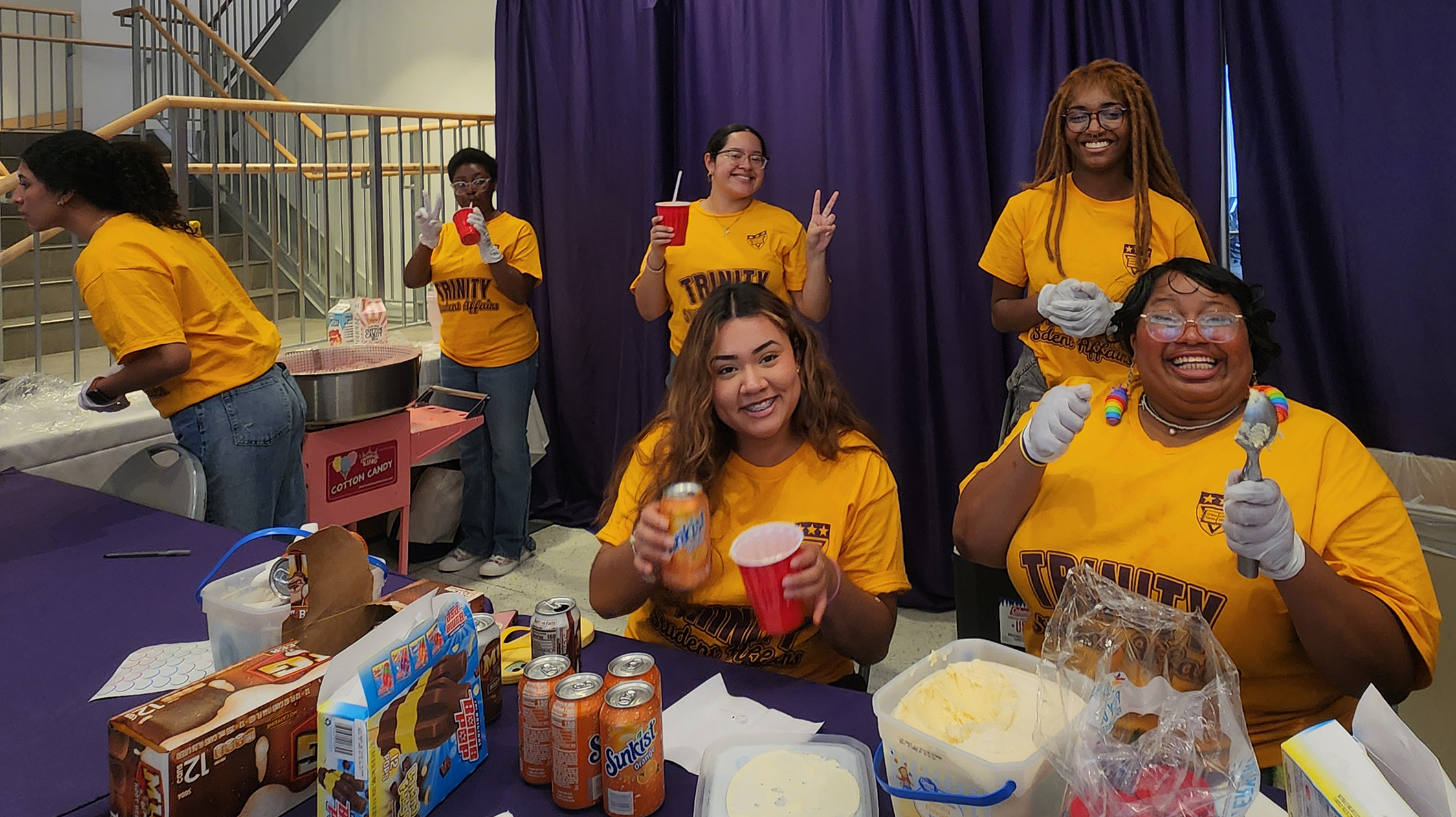
“It’s been a little stressful, but I love helping the new students,” said Moriah Turner, a second-year peer advisor.
Trinity senior Jimilehy Ramos, also a peer advisor, called the week “stressful, but… wonderful” because it’s all about “making connections with the new freshmen and the new transfer students.” Michelle Argueta, a second-year peer advisor, summed it up as “really fun. Very chaotic — in a good way.”
That sense of momentum extends to the campus itself. Fall semester at Trinity arrives with visible energy — renovations, refreshed learning tools and new supports that reshape how students eat, study and build community.
The most sweeping change is the upcoming two-year modernization of Alumnae Hall, Trinity’s historic hub for dining and residence life. Alumnae Hall will close at the end of the fall 2025 semester so construction can begin in January 2026. Campus dining will then shift to the first floor of Cuvilly Hall, which is currently being reconfigured to accommodate the transition.
The project will deliver “a beautiful, revitalized center for dining, residence and gathering spaces for all members of our campus community, supported by more than $40 million in private charitable gifts,” Trinity President Pat McGuire said. Regular updates are posted on Trinity’s website; from the homepage, click the “Campaign for Alumnae Hall” graphic and select “Project Updates Here.”
Just a short walk away, the creative heart of campus is expanding. The basement wing of Main Hall, tucked behind the post office, continues its transformation into the Evelyn Y. Davis Center for Journalism, Media & Communication.
“The newsroom, director’s office and conference room were all completed in early 2023, and work will continue this fall semester on a dedicated JAMS classroom and audio and video studio,” said Chaz Muth, newsroom director and chair of the Journalism and Media Studies Program. “Work is expected to continue in 2026 to install working restroom facilities, update a faculty room and complete more office space in the wing.”
The expanding footprint gives student journalists a proper home for reporting, production and classes in one contiguous space.
Academic support is also leveling up through the Research & Writing Center.
“The new Writing Our Way guide was designed as a ‘one-stop shop’ built from last year’s tutoring trends and multilingual learner feedback, focusing on citations, paragraph development, brainstorming strategies and research tips so that students feel more confident and independent when tackling their writing,” said Brianna Rae Johns, director of writing.
In response to graduate student requests, the center also launched virtual tutoring exclusively for graduate students, where writers share drafts ahead of time and then receive tailored feedback from a graduate-level tutor or the director of writing herself.
“Students can access the guide and book appointments through our Linktree via QR codes posted in the center (and shared by email), and graduate virtual sessions must be scheduled at least three days in advance to allow time for review,” Johns said.

Meanwhile, digital classrooms received a usability boost. Over the summer, Trinity upgraded Moodle, the university’s open-source learning management system, from version 3.11 to 4.5. The new version introduces a cleaner look and more intuitive navigation while keeping core features familiar.
Moodle — short for Modular Object-Oriented Dynamic Learning Environment — is widely used by schools, universities and organizations around the world to manage online courses and resources. The information on Trinity’s upgrade was provided in a campuswide email from technology support.
Day-to-day convenience and safety are getting attention too, based on on-site observations. New vending machines are being installed across campus, including in residence halls, the Payden Academic Center, the Sister Helen Sheehan Library and Main Hall, making late-night snacks and quick study essentials easier to grab. In residence halls, student ID access is now being used to streamline entry and reinforce security.
Finally, for students adjusting to college rhythms — whether returning or brand-new — community makes the difference. Residence life programs, team-building activities and student organization events can help turn unfamiliar spaces into connection. Research published in the Journal of American College Health in 2012 found that early participation in campus activities helps ease homesickness and builds confidence during the first weeks of college.
From the upcoming dining shift to Cuvilly, to an expanding journalism wing and a new writing guide with graduate virtual tutoring, the semester’s upgrades are more than cosmetic. These changes invest in the spaces, skills and supports that shape student life this fall and for years to come.