By Stephanie Batres, Erica Caraway, Destiny Gantt and Tamaria Palmer
Trinity Times Correspondents
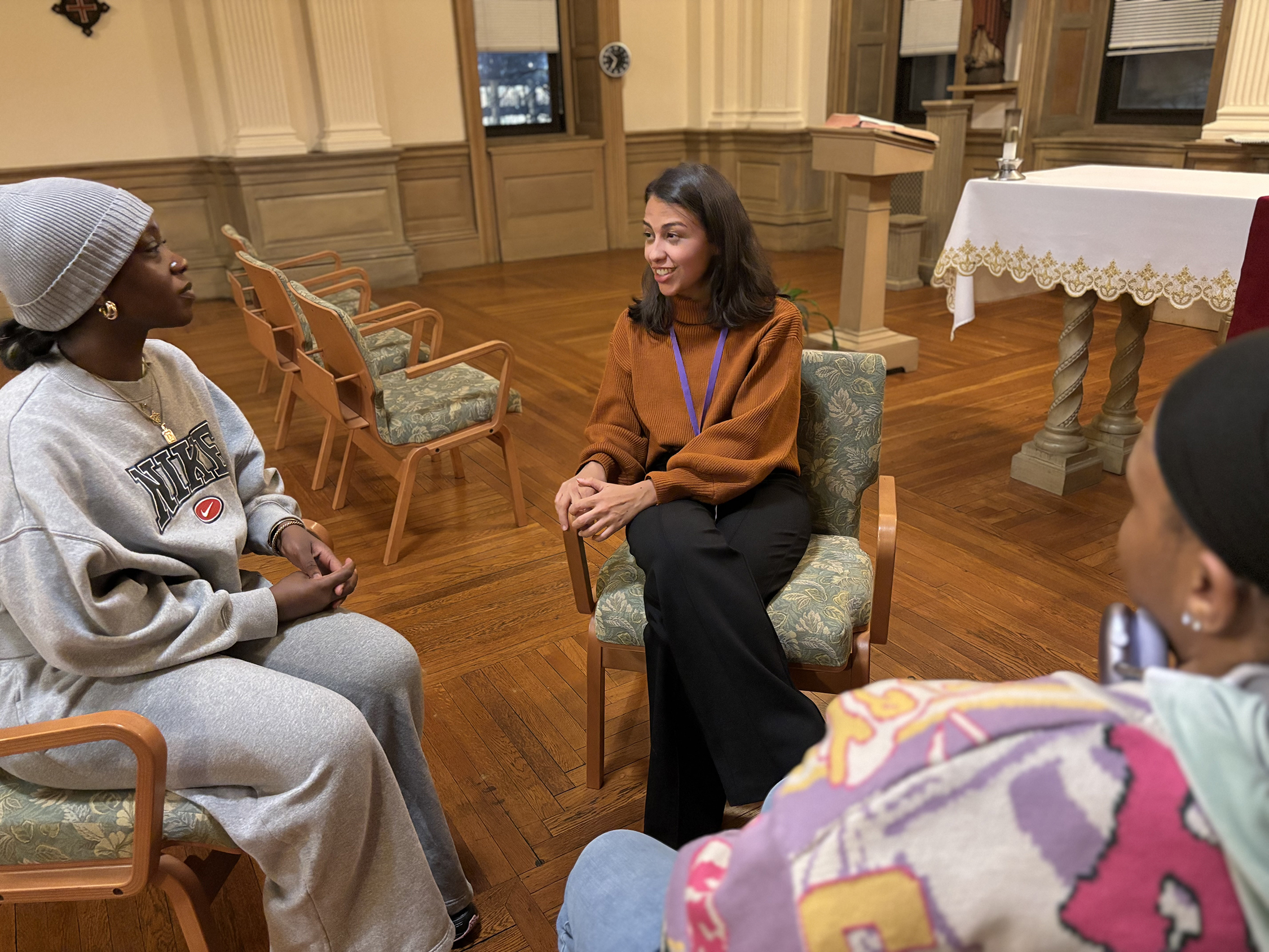
Talita Borges doesn’t look like a typical nun – because she isn’t one – and when she began her role in January as Trinity Washington University’s new director of campus ministry, it marked the first time in the school’s 127-year history that no vowed religious sister serves on its faculty or staff.
Borges, a lay consecrated member of the Focolare Movement known as a “focolarina,” lives in community and privately professes vows of poverty, chastity and obedience. Though she remains Catholic – like Trinity’s founding Sisters of Notre Dame de Namur – she is expected to bring a distinct perspective on religious life to her role.
The year 2025 saw the departure of the last sisters on the faculty and staff: Notre Dame Sister Camilla Burns, professor of religious history; Sister Mary Hayes, archivist, who first came to Trinity as a student in 1953; and Sister Ann Howard, campus minister.
Sister Ann arrived at Trinity in 2017 from Connecticut and immediately set to work revitalizing the university’s gospel choir, planning major liturgies, organizing the Cunneen Fellows Program and encouraging environmental responsibility. During her eight years on campus, she facilitated the planting of nearly 200 trees, making tangible for the university the message of Pope Francis’ 2015 encyclical, On Care for Our Common Home, in which the Holy Father quoted Patriarch Bartholomew: “inasmuch as we all generate small ecological damage, [we acknowledge] our contribution, smaller or greater, to the disfigurement and destruction of creation.”
Sister Ann was “ever present to each of us with good grace and humor…meeting with students in great need of spiritual and personal direction,” wrote Trinity President Patricia McGuire.
“The Sisters of Notre Dame [de Namur] have really provided us a grounding in social justice and reaching out to women who may not have had educational opportunities,” said Jeannine Marino, assistant professor of religious studies at Trinity.
Borges arrived on campus Jan. 12, 2026, as the new director of campus ministry. She came to Washington by way of her native Brazil, then Italy, Switzerland and the United Kingdom.
Borges is quick to point out that she is not a nun but a lay consecrated woman from the Focolare Movement. “Focolare” is Italian for “hearth,” invoking the spirit of a family’s main gathering place. Before founding the movement in Trent, Italy, in the 1940s, Chiara Lubich was a Franciscan tertiary at the height of World War II. Focolare was approved by Pope John XXIII in 1962 as a separate movement, officially known as the Work of Mary.
“This movement,” Borges said, “is recognized by the Catholic Church, but we have different vocations. I think that is the novelty.”
Members of the Focolare Movement serve in a variety of professions – as teachers, social workers, pilots and actors. The movement is open not only to Catholics but also to members of other Christian denominations and even agnostics.
“I’m working in a role that a nun filled before,” Borges said, “so it’s hard to understand, but I could be working for the World Bank. One of my colleagues works for the World Bank. She has a full-time eight-hour job there. We are a minority [in the Catholic Church], but we live as communities and families.”
To avoid confusion, Borges asks to be called simply by her first name. “In the Focolare Movement, we don’t have titles,” she said.
Though youthful in appearance, Borges brings 10 years of experience in ministry and interfaith outreach. Raised in an observant Catholic household in Brazil, she said her parents did not force religion on her.
“It was like, you can go if you want,” she said. “I try to bring this to my ministry. Each person is called to follow the path that makes the most sense [for them].”
She entered ministry part time in 2016 and later served throughout Europe, focusing on youth engagement and community building.
“I found out about the position [at Trinity] from a friend who is also in my community,” Borges said. She applied in August and began her role in January.
Trinity does not keep statistics on how many students identify as Catholic or religiously observant, and Borges acknowledges that some may not understand what a campus minister does.
“Campus ministry can be an umbrella for so many things,” Borges said. “We have a weekly Mass every Wednesday, so there’s all the preparation for that. And if someone wants the sacraments, I can facilitate this process for them. Another important area is the programs and activities for the students.”
She highlighted the university’s gospel choir and the student-run Trinity Sister Fellowship, which conducts weekly Bible studies. The Cunneen Fellowship, a 10-week paid internship focused on social justice, is also overseen by campus ministry.
“We have events during the year,” Borges said, “like the upcoming Interfaith Iftar for Ramadan (in conjunction with Trinity’s library and Marino’s Christ, the Church and Social Justice course). We have the alumni Mass in October, invocations at graduation ceremonies, the Blessing of Hands for nursing graduates, but [a major] point for me is communication with the students, faculty and staff.”
Trinity students have learned from the sisters who served before, Marino said. “Now we get to carry on their legacy…to stand on their shoulders, to keep promoting social justice causes, to keep advocating for the immigrant and the poor, to keep educating women in the heart of D.C.”
One strength Borges and the Focolare Movement bring to the university is a focus on inclusivity and interreligious dialogue. In the United States, three in 10 Americans identify as “nones,” which are religiously unaffiliated – atheist, agnostic or “nothing in particular.” A 2025 Pew Research study found that at 29%, the religiously unaffiliated outnumber evangelical Protestants (23%), Catholics (19%) and historically Black Protestants (5%).
Borges sees the diversity of views on campus as an opportunity for dialogue.
“I’m agnostic,” said Deja Little, a sophomore at Trinity. “I don’t think [campus ministry] has to do anything different in my case, but I can’t speak for other people.”
“I’ll be honest, [religion] isn’t really a part of my life,” said sophomore Lesly Hernandez. “It used to be, but not as much anymore. But I know [campus ministry] is holding something for Ramadan this year. Those types of opportunities to learn about other cultures and religions is something I’d like to see more of.”
Freshman Cherish McGowan and junior Sarah Diaz said religion remains a centering force in their lives and see campus ministry as a place for unity and support.
“There are so many ways we can incorporate [other religions and traditions] here on campus,” Borges said. “It’s a great way to get to know other cultures. This is something I’m really trying to pay attention to.”
Borges encourages students, faculty and staff with questions or suggestions to visit the campus ministry office in Main Hall, Room 224, or contact her by email. She maintains an open-door policy – and offers a hot cup of coffee.
Looking ahead, campus ministry may expand its presence on social media. While she has no immediate plans to launch a TikTok channel, Borges did not rule it out.
“If a student wants to propose a TikTok for campus ministry, why not?” she said. “I would love it.”
Hi Talita
Thanks for sharing your mission at
Trinity! I like your inclusivity, openess
to All Students and Staff as well as your
goal to build Community and to be
service oriented!
Blessings on your ministry!!
Sr Ellen Reilly SND de N