By Nayeli Martinez
Trinity Times Correspondent
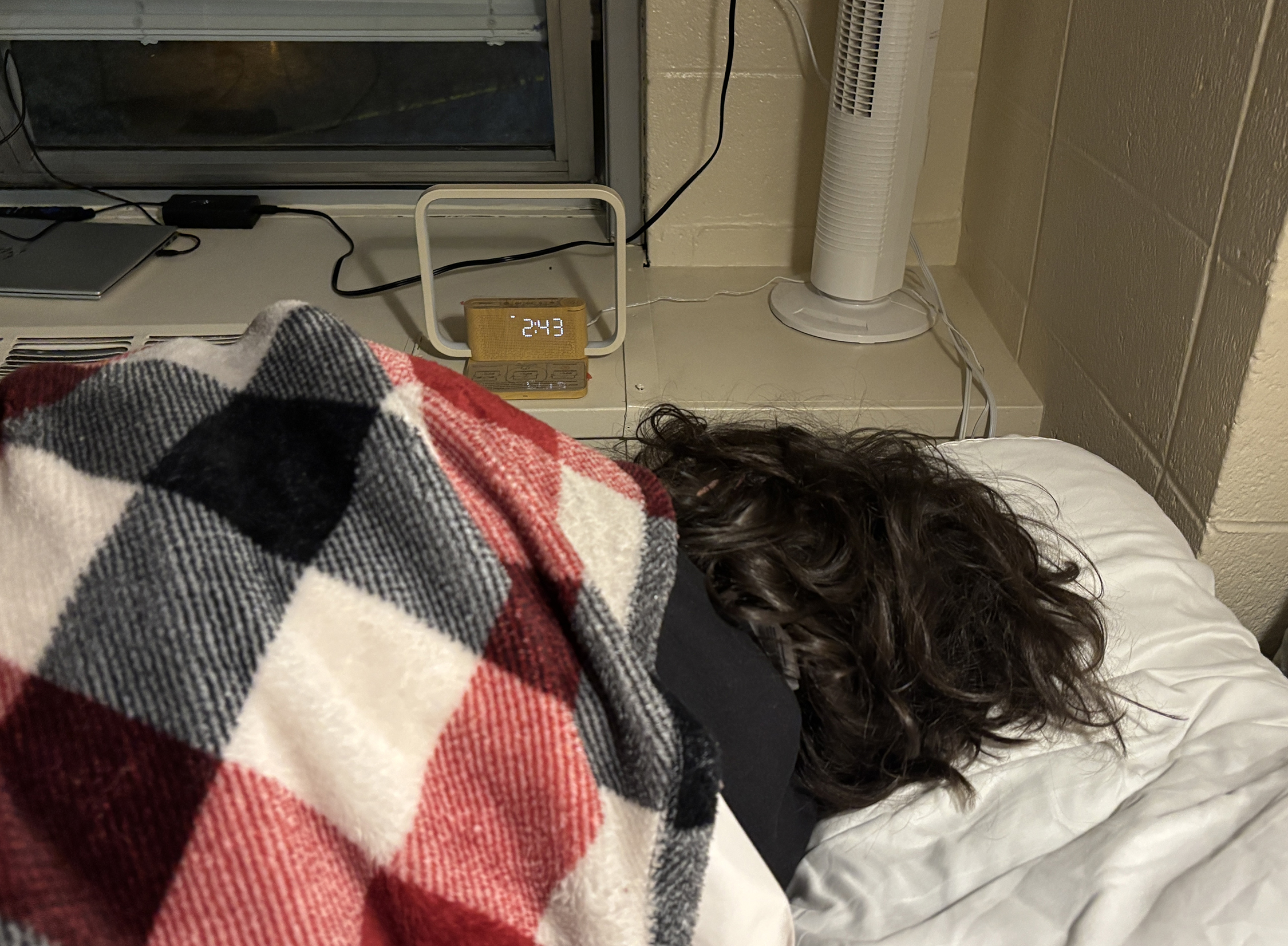
For Trinity Washington University junior Mayrene Diaz, getting enough sleep can be difficult. Like many college students, she has experienced her share of papers and late-night study sessions.
“I find that I lose sleep, mostly in fall semester, because of the time changes, and so my body just doesn’t sleep at a reasonable hour,” said Diaz, a global affairs major. “I usually cram my semesters from class to class, so more work, and that makes me lose sleep because I’m more focused on doing my work and studying rather than sleeping.”
Lack of sleep is an unspoken rule that many college students believe they must endure. Experts say, however, that missing valuable hours of sleep can affect academic performance, create unhealthy habits and lead to complicated relationships with sleep.
Jaysi Encarnacion-Ramirez said she believes her unusual sleeping habits have helped her academically.
“I’d seen that staying up late helped in the quality of my work because it’s putting pressure on me to make sure that if I’m staying up this late, it better be good,” said Encarnacion-Ramirez, a Trinity sophomore enrolled in the university’s Early College Academy, making her also a high school senior at Coolidge High School in Washington.
Encarnacion-Ramirez and Diaz have both been associated with the Early College Academy at Trinity. Diaz earned her associate degree in May 2025 and enrolled at the university as a junior in fall 2025. The District of Columbia program allows students to complete dual-enrollment classes at Trinity during their final two years of high school.
Both students said they expected some level of sleep deprivation in college, though only to an extent. They said there was even a sense of glamorization surrounding it.
According to a 2022 report by the Centers for Disease Control and Prevention, at least 60% of college students experience poor-quality sleep. The report also found that 75% of college students reported occasional sleep disturbances, while 15% reported poor sleep quality overall.
Angela Anderson, Trinity’s director of health services, said missing out on necessary sleep can have serious effects.
“Well, for one, when a student hasn’t slept enough, it can definitely increase anxiety and decrease the ability to focus,” Anderson said. She also emphasized how unhealthy habits in bed can interfere with how quickly someone falls asleep.
“If you make that [healthy] relationship with your bed, your body gets conditioned when it sees the bed, it knows you’re supposed to sleep in the bed,” Anderson said.
Phone addiction and procrastination are two factors that interfere with sleep, according to a 2022 study by the National Library of Medicine. The study found that “37.4% of the sample were addicted to smartphone use, while 7.7% had a high level of procrastination, and 62.8% had an average level of procrastination.”
“I find it easier to procrastinate, especially now with the rise of social media,” Diaz said. “Consuming so much social media makes me not want to do my work.”
Encarnacion-Ramirez echoed a similar sentiment but said she approaches the issue differently.
“I used to struggle with this [phone addiction] a lot,” she said. “So to combat that, I put my phone across the room or limit myself on the apps I use.”
Encarnacion-Ramirez said she has two phones. One is for personal use, and the other has strict entertainment limits. Splitting the load has proven effective, she said.
Some students, like Diaz, view sleep recovery as something to address after graduation.
“I personally think I will be able to fix it after I graduate, because I won’t be just studying,” she said. “I will be studying, possibly in my work and career, but it won’t be so rigorous.”
The Society of Behavioral Medicine recommends several sleep strategies, including maintaining a regular sleep schedule, being strategic about naps and keeping bedroom temperatures between 60 and 67 degrees.
Anderson also recommended a range of practices to help students improve their relationship with sleep.
“Aromatherapy is a real thing,” she said. “Scents like lavender are calming, while lemon and citrus scents are more alert. It’s a great mood stabilizer.”
She also recommended light reading before bed, soft ambient lighting to encourage a calm atmosphere, and “brain dumping” in a journal to clear the mind before sleep.
Despite falling into habits of sleep deprivation, students like Diaz and Encarnacion-Ramirez said they want to improve their sleep schedules.
“A teammate told me that for every hour you lose sleep is the equivalent of going to work under the influence of two [alcohol] shots,” Encarnacion-Ramirez said. “That is what I needed to hear as encouragement to fix my sleep schedule.”
