By Sydney Ware
Trinity Times Correspondent
Just a year into its existence, the Student-Athlete Advisory Committee (SAAC) at Trinity Washington University has started the 2026 spring semester ready to boost students involvement and build connections on campus.
As part of that effort, SAAC members and their advisor, Assistant Athletic Director Tierra Floyd, are planning their first-ever partnered event with Trinity’s Black Student Alliance (BSA).
In honor of Black History Month, the two organizations will host a game day where students can participate in a multitude of activities including trivia and “Family Feud.” Participants will test their knowledge of Black history, with small prizes for winners. The event will also include physical activities like a Double Dutch competition, a staple childhood game in Black culture.
SAAC and BSA members said they are excited for the event, which will take place Friday, Feb. 20, from noon to 2 p.m.
BSA President Anastasia Tomlinson said planning campus events can be time-consuming but worthwhile.
“It’s obviously a little daunting sometimes to go through all of the steps, because it’s always a lengthy process to get everything tied up,” Tomlinson said. “But it’s also always exciting to see the fruits of the labor.”
She stepped into the BSA leadership role at the end of last spring semester and has become familiar with the process of executing campus activities. Tomlinson described BSA’s event coordination as a group effort fueled by brainstorming.
“Someone comes up with an idea and we talk about it amongst the BSA and determine if that’s something we would like to do,” Tomlinson said. “And then when it comes to collaborations, we like to seek out people who have a common interest with us.”
With a large population of Black students on campus and in the athletics program, BSA saw a fun yet educational event that ties Black history and athletics together as an opportunity to provide students a sense of representation.
“I hope that we’ll all leave the event learning more than what we already knew concerning Black history,” Tomlinson said. “[Especially] when it comes to Black athletes, because there’s a lot I feel that gets brushed over.”
Under Floyd’s leadership, SAAC members have coordinated events they believe will help connect students across Trinity’s campus. For events like this one and last semester’s “Holiday Hangout,” almost all of the planning was student-led.
“In the planning process, I think it’s more student-led. They come up with the ideas and I kind of just organize things in the back to make sure we have a place to participate in these activities,” Floyd said. She explained that the model allows students to act as liaisons between their teams and administrators, ensuring students’ interests and ideas are represented.
“I want the students…to talk to their teams, get them more involved and create camaraderie,” Floyd said. “And I think the students are doing a good job…coming up with good ideas, tangible things for us to do, and then eventually growing with each event that we do.”

Athletes Na’Kiya Butler and Andrea Montano said SAAC follows a similar planning model to BSA’s: brainstorming ideas, reaching consensus and determining what can be executed. The pair feel that SAAC is a valuable way for student-atheletes to advocate for the athletics department.
“SAAC has made it easy to facilitate requests and uplift the department as a whole,” Montano said. They also praised their advisor’s approach, saying it has been an uplifting and motivating experience.
“Our advisor, Tierra, she’s done a really great job of just letting us take control over [SAAC] and letting us do what we feel is best for the athletes,” Montano said.
Both athletes said organizations like SAAC and BSA offer students opportunities to learn responsibility and build a community.
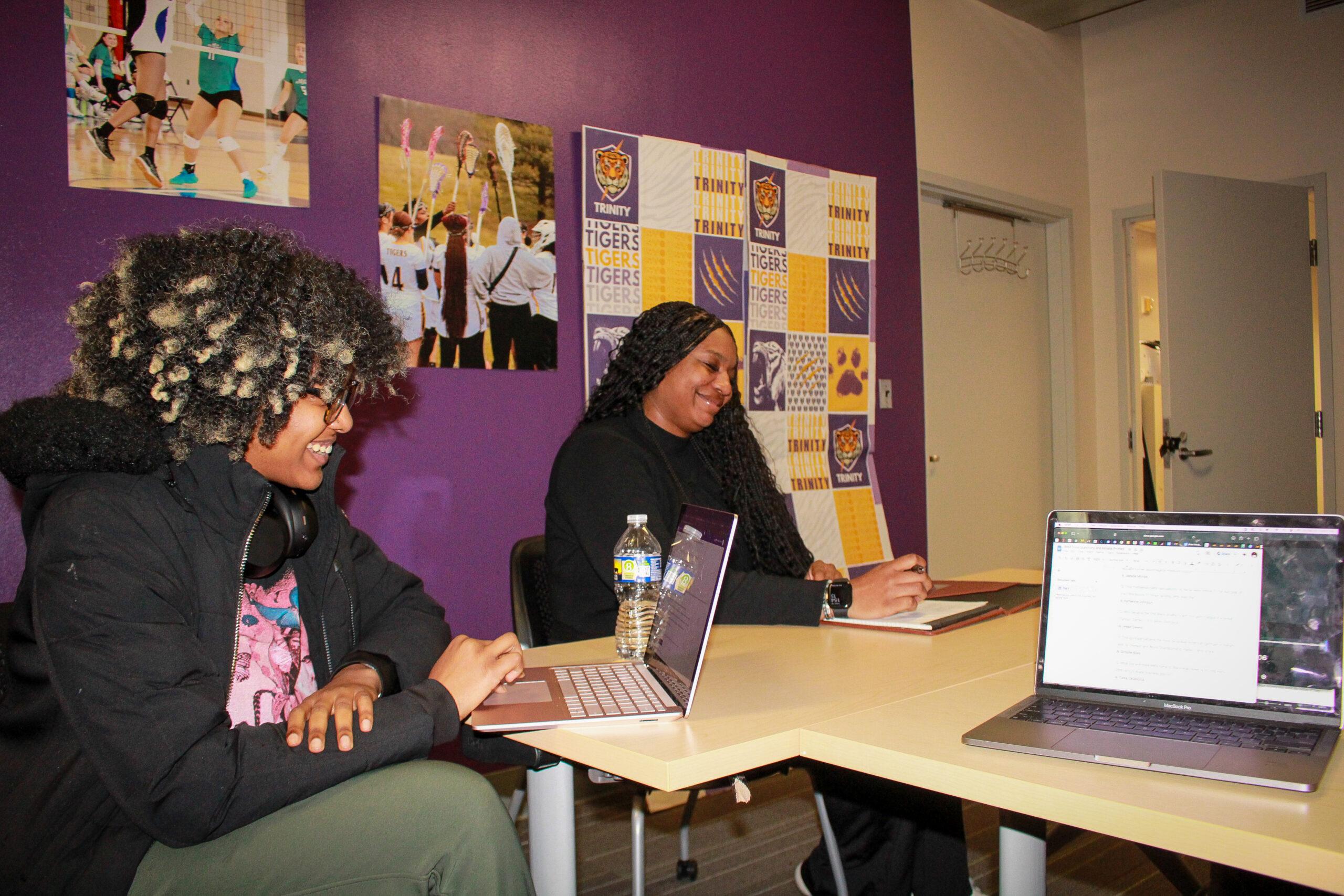
In their final meeting to prepare for the event, attendees said building community is a primary goal of both groups.
“I hope we can gain some type of community and work together again in terms of [advocacy,]” Butler said. “SAAC is supposed to be something that advocates for student athletes specifically, but I think it could become something more – where it stretches, not just through athletics, but all over campus.”
Similarly, Floyd hopes the event will strengthen connections beyond the university.
“I hope that everyone has a good time and I hope that we can start collabing on more things in the future,” she said. “I think [the event] will tie into us being able to do bigger things, not even just here at Trinity, but in the community in general.”