
By Sydney Ware
Trinity Times Correspondent
Social justice is a key component of creating impactful change and central to Trinity Washington University’s mission.
Each summer, a small group of students put that mission into practice through the Sister Seton Cunneen ’65 Fellowship, a paid program that places students in community service internships while they explore social issues through hands-on work.
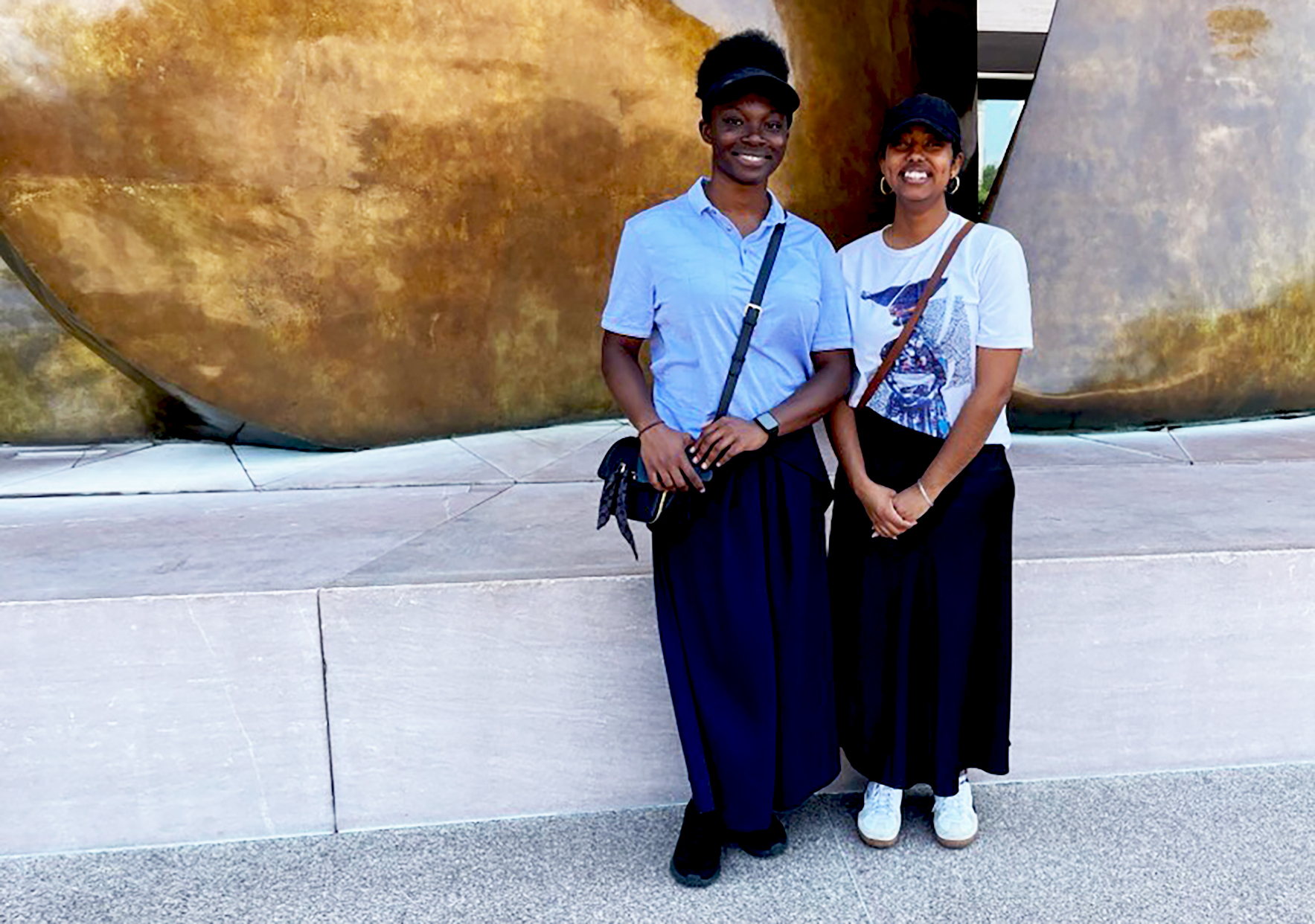
During the summer of 2025, three Trinity students – Margot Malumbu, Saron Gebereegziabhier and Maria Carmen Miko – were selected as Cunneen Fellows. The fellowship offers a paid, 10-week summer internship with nonprofit or social service organizations, allowing students to gain professional experience while engaging in service rooted in social justice.
Karen Gerlach, Trinity’s vice president of student affairs, said the application process is designed to encourage initiative and responsibility.
“We like students to find a nonprofit, something that’s either in a field that they’re interested in or an area that they want to do service work in,” Gerlach said. “Then they talk to the organization to make sure that they’re willing to accept them as a volunteer. And then the application asks basic information about who the student is, why they’re interested in their chosen organization, and what the work they would be doing is.”
Malumbu, a nursing student, spent her fellowship at MedStar Washington Hospital Center, where she had previously volunteered. She learned about the Cunneen Fellowship from Notre Dame Sister Ann Howard, who retired last summer as Trinity’s director of campus ministry and formerly directed the program.

“I was searching for a place where I could see, since I’m in the nursing program, the way everything works for a nurse,” Malumbu said. “[Sister Ann] explained to me the process, and that’s how I got interested in it.”
Malumbu said she was thrilled when she was selected for the fellowship.
“I was happy. First, because I extended my time to volunteer more at MedStar hospital and have new experiences with patients,” she said. “The little conversations with patients really motivated me to actually dive into my nursing program, really focus on my lesson work, because it’s really rewarding – not just with the money, aside from the money – but it’s [the] emotional connection with the patients.”
Gebereegziabhier, a psychology and journalism major, learned about the fellowship through former participants and research on Trinity’s website. While searching for an organization aligned with her interests, she discovered Project Blackbird, a nonprofit that works to destigmatize mental health through storytelling.
“I was honored to be selected as part of the fellowship, because it’s a tradition that Trinity holds,” Gebereegziabhier said. “It was like, ‘Oh, you’re part of it too!’ And I was extremely excited about the part that I get to get real life experiences that I can bring back to school and be able to understand more about what both of the career options that I’m going after.”
Both students said the fellowship came with a learning curve. At the start of their internships, they felt nervous and unsure, but those feelings faded as they became more comfortable in professional environments.
At Project Blackbird, Gebereegziabhier said adjusting to expectations was initially intimidating.
“You’re working with people who are professionals in their fields,” she said. “You have higher expectations to deliver.
“It took me a couple of weeks to get into the beat of how to do things and how to manage my time, how to appear in front of people, how to converse, how to be able to express my opinions and not shy away from actually giving my opinions and being able to deliver,” Gebereegziabhier said.
Malumbu also encountered challenges, including concerns about representing Trinity well and navigating workplace dynamics. She said she turned to Sister Ann for guidance and encouragement. Eventually, she switched departments at the hospital, finding a more supportive environment.
Both Gebereegziabhier and Malumbu called their fellowship incredible experiences, leaving both students feeling very fulfilled.
“In the emergency department I was able to work properly and really be seen,” Malumbu said. “I was surrounded by people that could actually appreciate my work, and that really taught me that not everybody will understand your work ethic, but you have to stand up for yourself and change your environment if you need to, in order to have a good outcome.”
The Sister Seton Cunneen ’65 Fellowship awards $4,500 to each selected student and is funded by the Maurice R. Robinson Fund. Fellows work full time during the summer while participating in structured reflection focused on issues such as poverty, education, health care and human rights. Three students are selected each year.
The fellowship is named for Sister Seton Cunneen, a 1965 Trinity alumna and longtime member of the Sisters of Notre Dame de Namur. After earning a degree in Greek and Latin, Cunneen later returned to Trinity as a faculty member and later served as director of campus ministry. She was instrumental in expanding student service programs that connected academic learning with community engagement and social justice.
Trinity established the fellowship in 1996 to honor Sister Cunneen’s legacy of faith in action and commitment to serving marginalized communities.
Sister Seton Cunneen was widely beloved as the university’s campus minister in the 1990s, Trinity President Patricia McGuire told Trinity Times. She was known for pioneering Trinity’s first long-distance community service trip to Apopka, Florida, where her friend and colleague Sister Ann Kendrick ’66 ran the Hope Farmworkers Ministry. For several years, Sister Cunneen led groups of students to Apopka, where they spent a week working alongside farmworkers near Orlando.
McGuire said Sister Cunneen’s devotion to service learning reflected the university’s mission in social justice and directly inspired the development of the Seton Cunneen Summer Fellowships.
“Her vision was that students could combine service with learning in a way that truly embodies Trinity’s values,” McGuire said,with the fellowship program being made possible through the generosity of the Maurice R. Robinson Fund, whose founders had personal ties to Sister Cunneen and shared her commitment to education and social service.
The university president noted that Cunneen’s idea for the fellowship “was a marvelous concept” that quickly took root. Florence Robinson, a member of Trinity’s Class of 1930, and her husband Maurice, founder of what became Scholastic, supported the program, along with their daughter Flo Robinson Ford, a close friend of the Notre Dame nun. The fund’s backing allowed the summer fellowship to provide students with paid internships that emphasize hands-on service, reflection, and engagement with social justice issues.
Although Cunneen later moved on from Trinity to share her ministry at Gonzaga College High School, she returned often to celebrate the fellows and encourage students in their work. McGuire said that while Cunneen’s life was tragically cut short by COVID-19 in 2021, “her influence and intrepid spirit of service live on through the Cunneen Fellowship Program,” continuing to inspire generations of Trinity students.
Gerlach re-emphasized that the fellowship continues to play an important role in supporting students who want to engage in service while managing financial realities.
“It’s so important because students often need that funding to help them when they’re coming back to school, and it helps them with their living expenses [during the fellowship],” she said. “But they can still volunteer, and provide these important hours to nonprofits who don’t have the funding to pay them.
“We’ve had students who’ve worked with undocumented immigrants, we’ve had students who’ve worked in health education, we’ve had students work with other nonprofits in the city,” Gerlach said. “I think that it’s more compelling when they’re connecting their book learning to their hands-on experience and showcasing how that’s going to help them as a Trinity student all-around.”