
By Sondreen Johnson
Trinity Times Correspondent
Trinity Washington University is a woman’s college, but it’s not unusual to find a few male students in the school’s classrooms.
Though largely considered a woman’s institution of higher education, Trinity graduate student Maalik Hawkins proudly pursues his master’s degree in strategic communication and public relations and says the mostly female student environment doesn’t provide him with any sense of masculine insecurity.
Though Hawkin’s gender only makes up about 5% of Trinity’s current student body, he appreciates the value the majority female representation of his classmates brings to the environment and said he doesn’t feel like he’s lacking a male presence. “Most of my professors are males.”
The Sisters of Notre Dame de Namur founded then Trinity College in 1895 as the first Catholic liberal arts college for women in the U.S. Their mission was to provide women – who were then barred from attending The Catholic University of America across street from Trinity’s campus and many other colleges across the nation – with higher education opportunities.
Though Trinity began enrolling men into classes in the mid-1960s – like the other historic women’s colleges still operating in the U.S. – it maintains “an active mission to include and promote the education and advancement of women in a society that still has too many barriers for too many women who want to get ahead economically and socially,” said Trinity President Patricia McGuire.
The predominate female student body is what attracted Precious Butler when she enrolled at Trinity Washington University in the fall of 2019.
For Butler, the school’s commitment to the education of women is personal, making her graduation from the university in May of 2024 that much more meaningful to her.
“I love our culture,” she said of the Trinity community of students, faculty, staff and alumni. “I love the fact that Trinity is a prominently female-based university, and I believe that it should stay that way, mainly when you consider the mission and history that Trinity prides itself on.”
The university’s Statement of Mission asserts that Trinity is a comprehensive university offering a broad range of educational programs that prepare students across the lifetime for the intellectual, ethical and spiritual dimensions of present-day work, civic and family life.
Trinity’s core mission values and characteristics highlight a commitment to the education of women, foundation for learning in the liberal arts, integration of liberal learning with professional preparation, and grounding in the mission of the Sisters of Notre Dame de Namur.
In addition to maintaining its commitment to the advancement of women, Trinity continues its historic mission of serving underserved communities with a student body that is also predominately Black and Latinx.
“It is inspiring, particularly when we see the sexism and racism that Black and Latinx women experience in the workplace and in higher education in general,” said Jamal Watson, associate dean of Trinity’s School of Professional and Graduate Studies and a professor of strategic communication and public relations. “At Trinity, they have a place at the table and having been in largely all-white academic settings, it is gratifying and exciting to see our minority women excelling in our programs.”
That inspiration extends to Trinity students like Hawkins, who told Trinity Times that he is offered a different prospective from the predominately female student body.
It’s also allowed him to appreciate why women could benefit from Trinity’s campus environment.
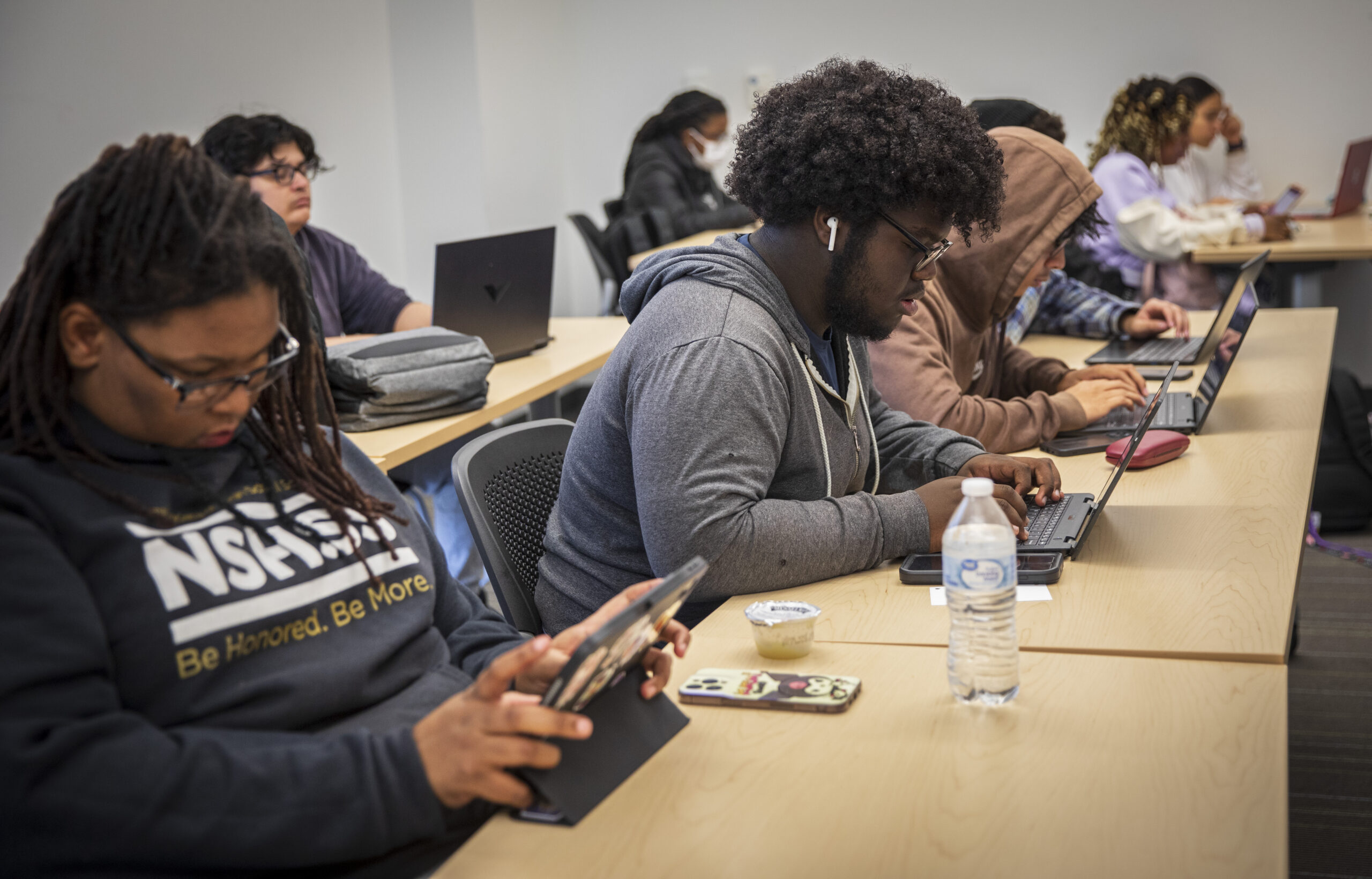
“The pros of attending an all-female based institution are that it allows women to have an open and honest space without feeling like they are being judged by an opposite gender,” Hawkins said. “Although the disadvantage of that comes with the lack of a different prospective.”
A 2018 study by the National Library of Medicine found little evidence to skeptic concerns that high school and college students who attend single-sex schools tend to reduce opportunities for mixed-gender interactions and increase mixed-gender anxiety.
However, having access to numerous perspectives and experiences creates more prospects, reduces the mental effort needed to battle stereotypes, and improves the overall attitude of the institution, the study said.
Though students and educators often value the commitment to the education of women in the community, advocates of mixed-gender institutions believe that having a male perspective in the classroom creates gender balance in the learning environment.
“Men are also enrolled in the School of Professional Studies where they take undergraduate courses, so there is representation” at Trinity, Watson said. “Traditions are important, particularly when we think about the exclusion of women in higher education spaces. So, I think it is particularly meaningful that Trinity has maintained true to its commitment of providing undergraduate students a safe space to learn and grow with their other sisters.”
Though the numbers of men enrolled at Trinity are small, most programs at the university are considered co-educational, said Trinity Provost Carlota Ocampo.
“The College of Arts & Sciences is all women, (but) the other units are coeducational,” Ocampo said. “We should not parse this out by programs but rather by units, as different units offer the same programs. Trinity is allowed to maintain our women’s college as an exemption to Title IX, but the law requires all other programs to be coed.”

There are 30 remaining women’s colleges in the U.S., and of that group, only about six are 100% female, the remainder are 90-99% female, and like Trinity, most have some men enrolled in some programs, McGuire said.
There are just eight remaining Catholic women’s colleges in the U.S. – down from a high of about 170 in 1960 – and all of them look like Trinity, she said.
“We do not see enrolling some men as diminishing our commitment to women,” McGuire said. “Rather, like HBCUs that enroll students of many races, or Catholic colleges that enroll many religions, we maintain our primary mission focus on women while also being inclusive for men who can thrive here.”