By Brittany McAlister
Trinity Times Correspondent
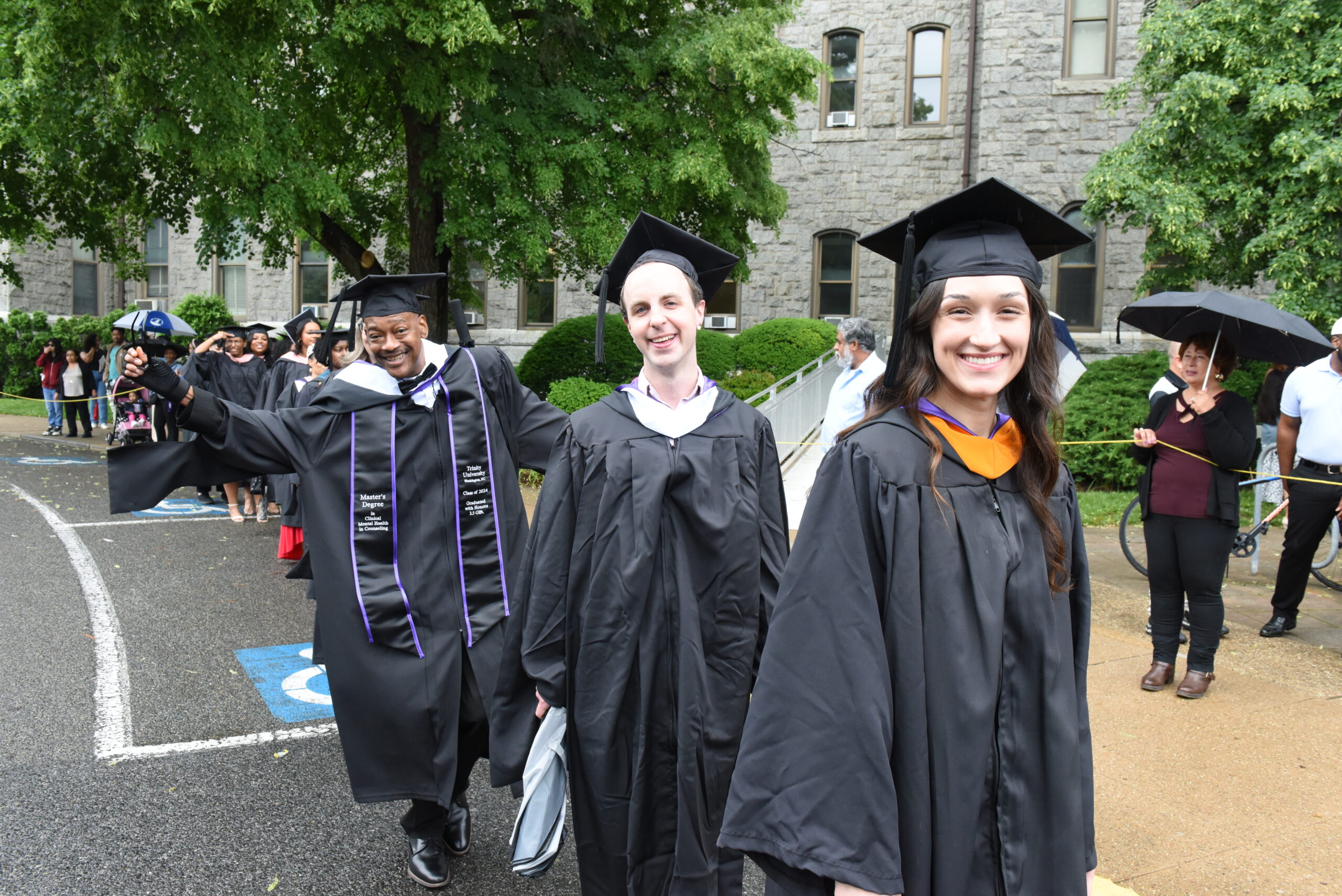
As Trinity Washington University students assembled on the university’s front lawn to receive their hard-earned diplomas last May, many looked at the graduation ceremony as a pivotal moment in their life’s journey.
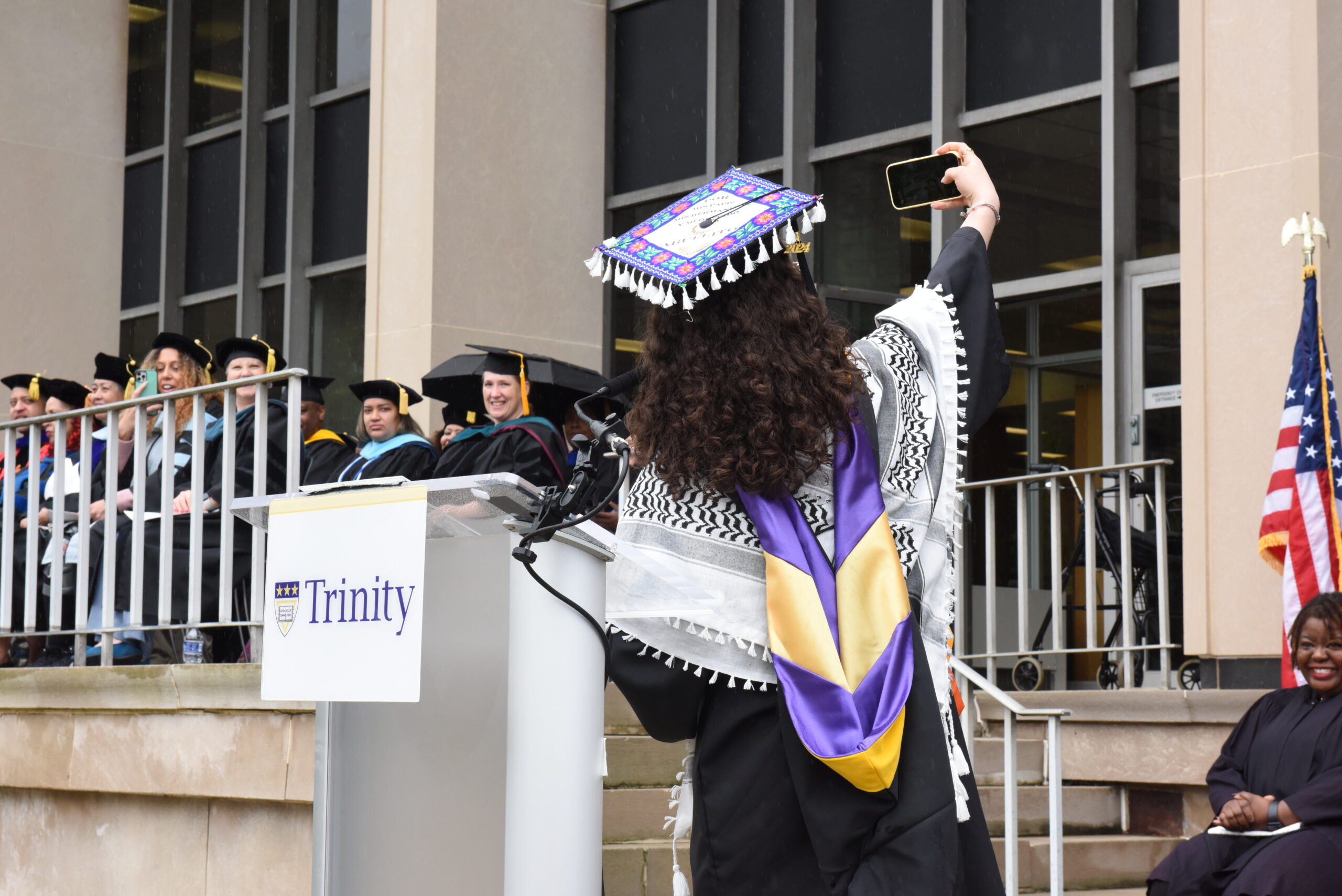
The May 18, 2024, commencement ceremony offered new Trinity graduate Karla Nunez Perez a moment to shine as a valedictorian and she took the opportunity to snap a selfie to mark the occasion before delivering her address to fellow graduates.
Perez – a Public Health and Sociology major who graduated summa cum laude – told the cheering audience getting wet from the drizzling rain that all essential moments in one’s life should be documented with a selfie and that college graduation was a focal juncture.
Then she encouraged Trinity’s Class of 2024 to go out in the world and make an impact.
“Go out there and pay attention, ask questions, don’t settle,” Perez told her peers. “Refuse to be defined by societal norms, and if doors are closed shut in your face, turn around and build yourself a new one. And remember, when you make it up there, to the tippy top, don’t forget to unlock the door for those behind you.”
Trinity celebrated its 121st commencement for its more than 360 graduates with two ceremonies. The evening of May 17 presenting degrees to students in the School of Professional Studies, the School of Business and Graduate Studies, and the School of Education. The morning of May 18 presented degrees to the students in the Early College Academy, the College of Arts and Sciences and the School of Nursing and Health Professions.
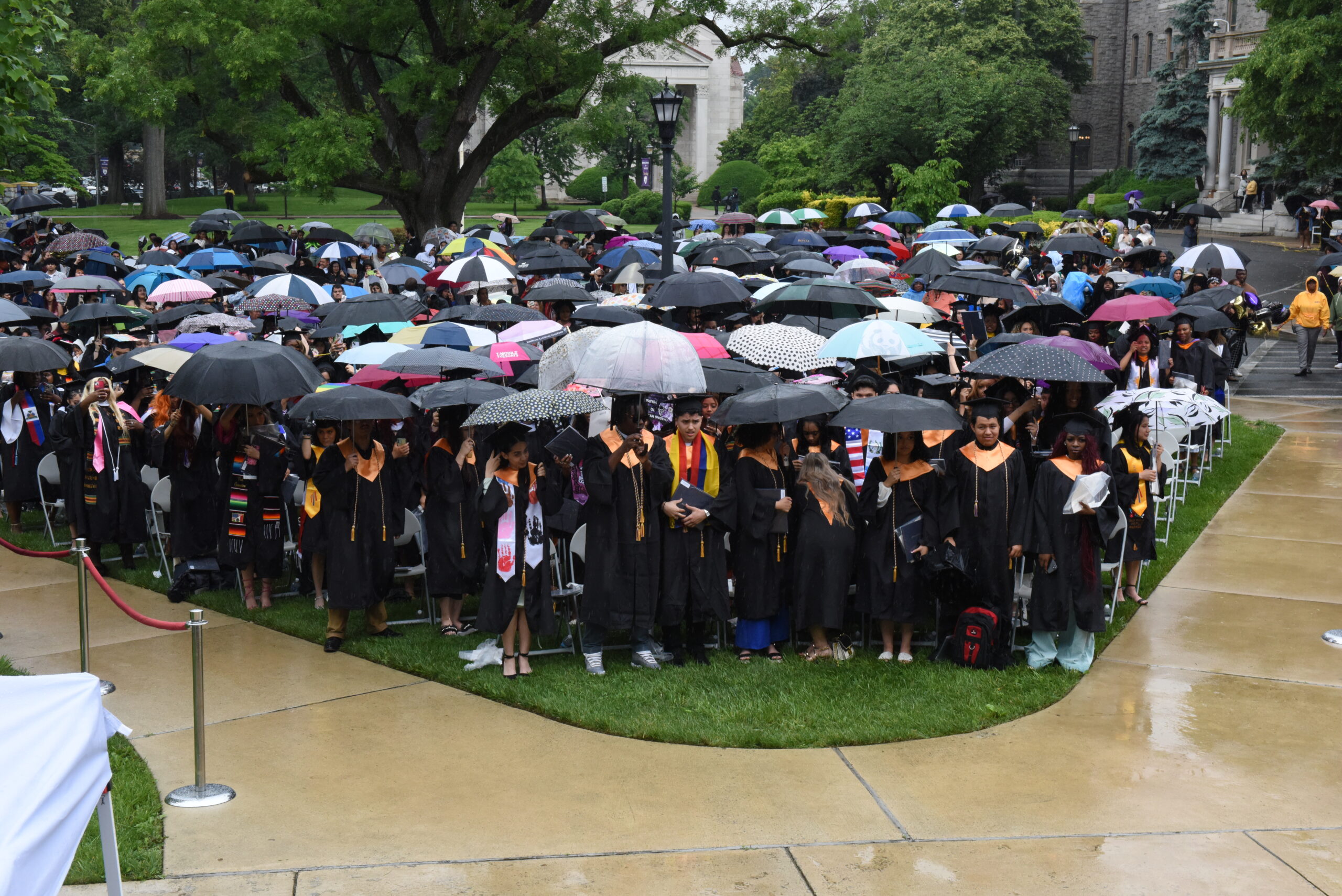
Though Washington’s spring weather delivered light rain for the two ceremonies, both were still heralded as momentous occasions for graduating students, their families, faculty and staff.
The graduation ceremony is a time-honored tradition that recognizes the hard work and dedication of students and serves as a reminder of the importance of education in shaping the future.
“Congratulations to all of our graduates in the Class of 2024,” Trinity President Patricia McGuire told the students she was about to hand diplomas. “We continue our celebration of Trinity’s 125th anniversary era, recalling the courage of the religious women who blazed trails 12 decades ago so that our students today could walk across this stage armed with the knowledge and skills they need to thrive in the larger society.”
Receiving associate’s, bachelor’s and master’s degrees is a pivotal point in a person’s life, one that launches them into a whole new chapter, McGuire said
The Bachelor of Arts degree signifies and certifies the entire breadth of learning in the liberal arts that has been part of a student’s academic program, not just a student’s major, she said.
“A student’s major program may be in Global Affairs, History, Journalism and Media Studies, or in Political Science for example,” McGuire told Trinity Times. “But that is not part of the name of the degree since a student’s transcript shows a student’s major program and courses taken at a university.”
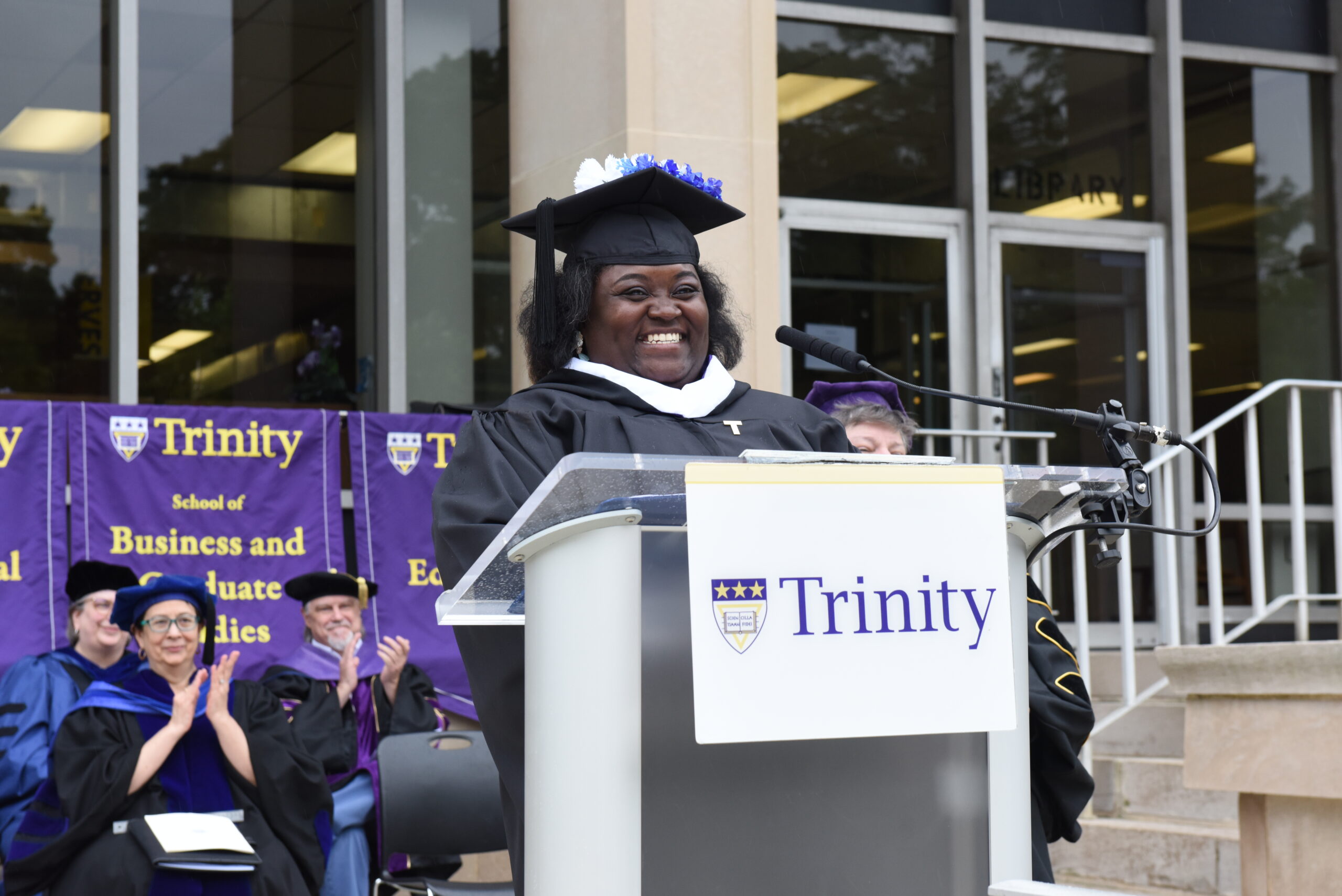
New Trinity graduate Kiera Thomas absorbed the graduation message during the ceremony and understood the enormity of this juncture in her life, while standing in her cap and gown.
Thomas also told Trinity Times that many of her peers understand the struggle of being a college student and to say she’s done with this chapter is bittersweet but rewarding.
“I do believe I’ve reached a milestone because whether or not you go, everyone has thoughts of what it’s like to go to college,” she said. “To be able to say I am a college student is cool but to say I’m a college graduate, that’s on a different level of achievement.”
As Thomas prepares to forge ahead in the world post-graduation armed with a bachelor’s degree, she said she is taking with her the sense of community she learned how to build at Trinity.
“Being in college, you learn to create a village,” she said. “My village came from my job, being on campus, and my family. I’m glad that I have an amazing village that I am to celebrate with.”
Trinity College was founded in 1897 by the Sisters of Notre Dame de Namur as a Catholic women’s college at a time when many institutions of higher education did not admit female students.
Now a university, Trinity is known for its commitment to social justice, as well as its diverse student body which reflects the rich cultural and ethnic tapestry of Washington.
The first colleges and universities in the U.S. can be traced back to the colonial 17th century with institutions like Harvard in Massachusetts and the College of William & Mary in Virginia. Established by religious denominations, most early American colleges were set up to train ministers.
The 19th and 20th centuries saw a significant expansion of higher education with the Morrill Act of 1862 paving the way for the creation of land grant universities and making education more accessible to a wider range of students.
Today, a college education is often viewed as a necessary step toward a successful career and a higher standard of living.
Studies have shown that college graduates tend to earn more money and have better job prospects than those with only a high school diploma.

According to the Pew Research Center, a college education can provide individuals with critical thinking skills, communication abilities, and specialized knowledge in their chosen field and suggests that a lack of college graduates can limit innovation and economic growth as highly skilled individuals essential for driving progress in a society’s various fields.
“A college education in the liberal arts gives students a broad set of skills and knowledge,” said Sita Ramamurti, dean of Trinity’s College of Arts and Sciences. “I want students to identify their interest and passion early on so they can choose their electives wisely to expand and strengthen their talent in that interest area.”
This philosophy channels students to be prepared and ready to step into a career that can harness their talent, Ramamurti told Trinity Times. “People are more productive and satisfied if their career matches their passion.”
Though Ramamurti acknowledged that a college degree frequently makes job applicants more attractive to employers, she stressed the education provides more than specific employment skills.
“Higher levels of education expand our thinking and make us more creative,” she said. “I can see students with such characteristics working on solutions to real world problems, thereby helping alleviate societal issues. Students with higher order thinking can contribute to society through advocacy, initiatives, inventions that can improve life, thereby shaping it for future generations to follow.”