By Kia Ross
Trinity Times Correspondent
Trinity Washington University student Donyah Bunn’s college education path appeared unlikely to her when she was a teenager with “strenuous” living circumstances.
A native of some of Washington’s lower-income neighborhoods, Bunn wanted something more for herself when she entered her 20s and enrolled in Trinity’s satellite campus “THEARC” in 2021.
After receiving an associate’s degree in Early Childhood Education in 2023, Bunn transitioned to the main campus to continue her studies in the university’s Journalism and Media Studies program with the goal of receiving her bachelor’s degree.
“I was a screw up,” Bunn told Trinity Times. “The fact that I turned my whole life around between (the ages of) 16 and 28 is honestly pushing me to finish my next degree.”
Bunn is a Black Washington native, raised by her mother and her grandmother in a lower-income area of the District of Columbia.
Toward the end of the 20th century, she would have stood apart from Trinity’s student body.
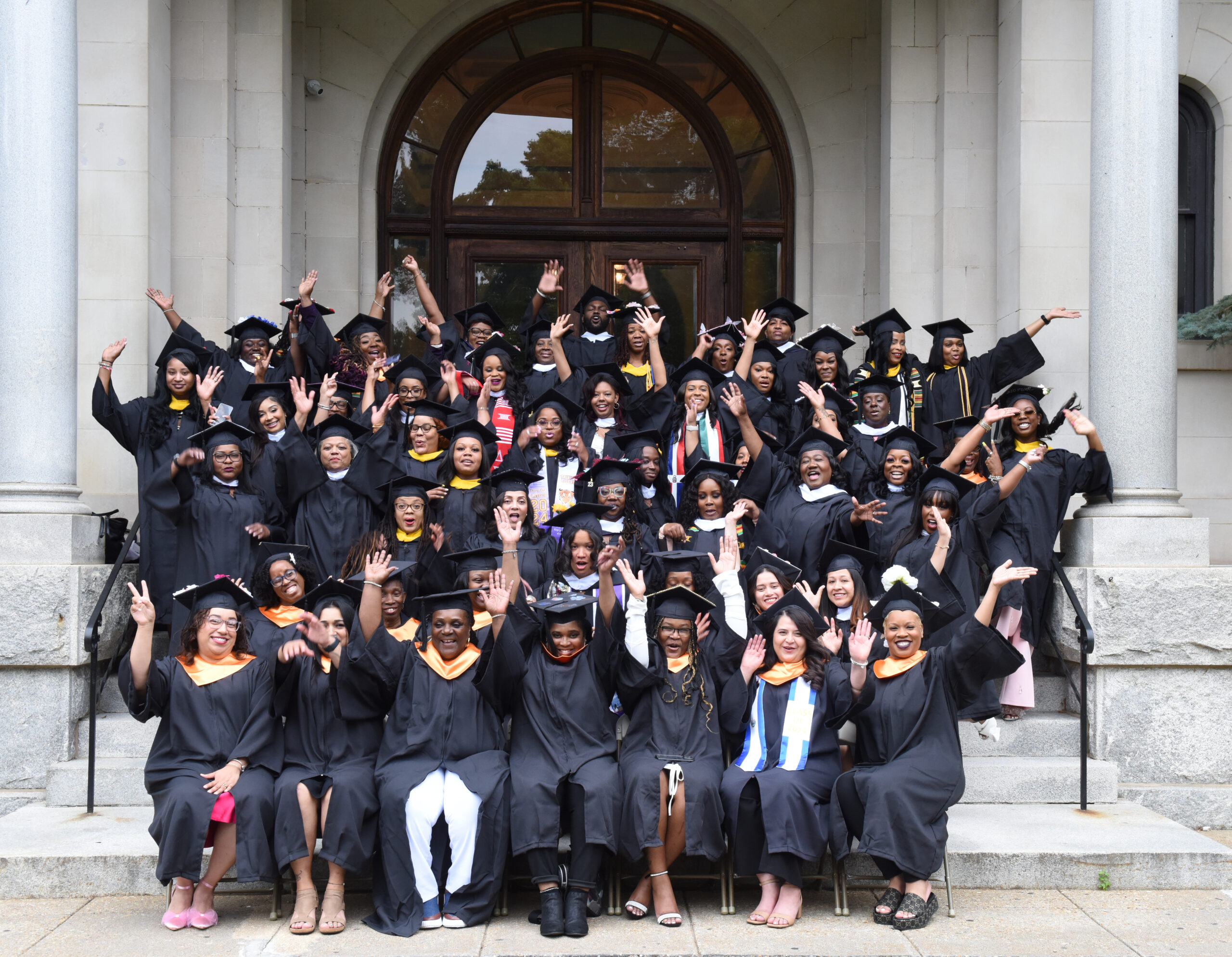
However, in 2024, she studies at a university where most of the student body are women of color, many of whom describe their upbringing similarly to hers, moving from one apartment to another, constantly living on top of other people.
“We saw and had heard shootings around the neighborhood,” Bunn said.
Throughout the 20th century, Trinity’s student body mostly consisted of young white women from privileged families who attended private Catholic schools, whose alumni include former House Speaker Nancy Pelosi, former Director of U.S. Health and Human Services Kathleen Sebelius and Kellyanne Conway, best known as an adviser in the Trump Administration.
The demographics began to shift in the 1990s when the school’s mission focused on women of color, individuals from non-Catholic backgrounds, with very low incomes, and frequently, they are the pioneering members of their families to pursue a college education.
“I was not planning to go to college,” Bunn said, and certainly didn’t envision herself earning a degree.
As a child she had attended numerous schools, and her life was so tumultuous that she didn’t believe she’d survive past 16.
Personal heartbreak struck in 2024 when Bunn’s grandmother died.
She remembers the joy and pride her grandmother felt whenever Bunn talked about school. Her grandmother had an unshakeable faith that Bunn could overcome the disadvantages of her background, much like the first Black students who attended then Trinity College more than 70 years ago.
Today so many Trinity students have unique success stories.
All of them, to one degree or another, embody the university’s mission, which has transformed in the first few decades in the 21st century by leaning into the education of traditionally underserved communities.
Patricia McGuire, the current university president, and Trinity alum has spoken about the origins of Trinity as a place of progressive refuge, and though the background of the student body may have changed, the mission of the school is largely like its founding.
The Sisters of Notre Dame de Namur founded the school in 1897 because women were being denied access to The Catholic University of America.
These women religious followed in the trailblazing footsteps of women’s colleges like Wellesley College and Smith College.

The modernism of the Progressive Era did not, however, extend to women of color. As a private college, it simply wasn’t accessible to most women living in poverty.
McGuire has led Trinity for 35 years and has worked hard to break the university away from this type of access.
It’s been her goal to transform the school, which has now become a university, as an institution welcoming to all students.
“In the 1970s I was a ‘scholarship girl,'” McGuire said, “and there were not that many ‘scholarship girls’ here. Most of the young ladies were wealthy.”
McGuire shepherded Trinity’s growth in the early 2000s through a period that began welcoming men into several of its undergraduate and graduate programs.
Currently, eight out of 10 Trinity students are female, but the university continues to strive for greater diversity.
Today, the mission of Trinity is still rooted in enabling a pathway through higher education for students who may not fit typical standards of academic eligibility — such as young mothers, transfer students and students returning after an educational hiatus.
“It’s about all the barriers that women have to face and how Trinity can help to move those barriers,” McGuire said.
She recognizes women, immigrants and people of color are still fighting for equality, but the battleground has changed.
“Over the course of the last 30 years,” McGuire said, “we have recognized the racial (and social) barriers that existed at Trinity. We worked hard to remove those barriers and become an institution that would be welcoming for all students.”

The first time Trinity really faced its racial barriers was during the Civil Rights Movement.
When Cardinal Patrick O’Boyle became the Archbishop of Washington in 1948, he immediately ordered the desegregation of all Catholic schools, agencies, and parishes within the archdiocese, said Trinity archivist Sister Mary Hayes.
Sister Mary attended Trinity during the time when Black women were finally invited to campus. She admits, however, that racism still existed.
Students “experienced racism on campus, and by about 1966 they began to organize,” she said. “They created the Afro-American Society.”
This society – which later transitioned into the Black Student Alliance – became one of the most active organizations on campus and a major force for equality, an enormous accomplishment considering the number of students of color hovered just below 3% of the student body in the 1960s, Sister Mary said.
Trinity scholarships, federal grants and other forms of financial aid paved the way for Black women like Sylvia Washington Ba to attend the college in 1954.
After receiving a PhD, Washington-Ba became the first full time Black faculty member at Trinity in the 1960s, later became the press attaché to the Senegalese Embassy in Washington, and in 1973 Princeton University Press published her book “The Concept of Negritude in the Poetry of Leopold Sedar Senghor.”
“We are standing on the shoulders of prior generations,” McGuire said. “The support of 12 generations of Trinity built what we have today. Take full advantage of every opportunity here. Do not sit on the sidelines. Get involved.”
The article was amazing , so proud of you Kia. Keep striving for greatness!