By Anette Perez, Genesis Bu-Chinchilla and Saron Gebereegziabhier
Trinity Times Correspondents
The 2024–25 academic year was marked by anxiety and uncertainty for student journalists across the United States.
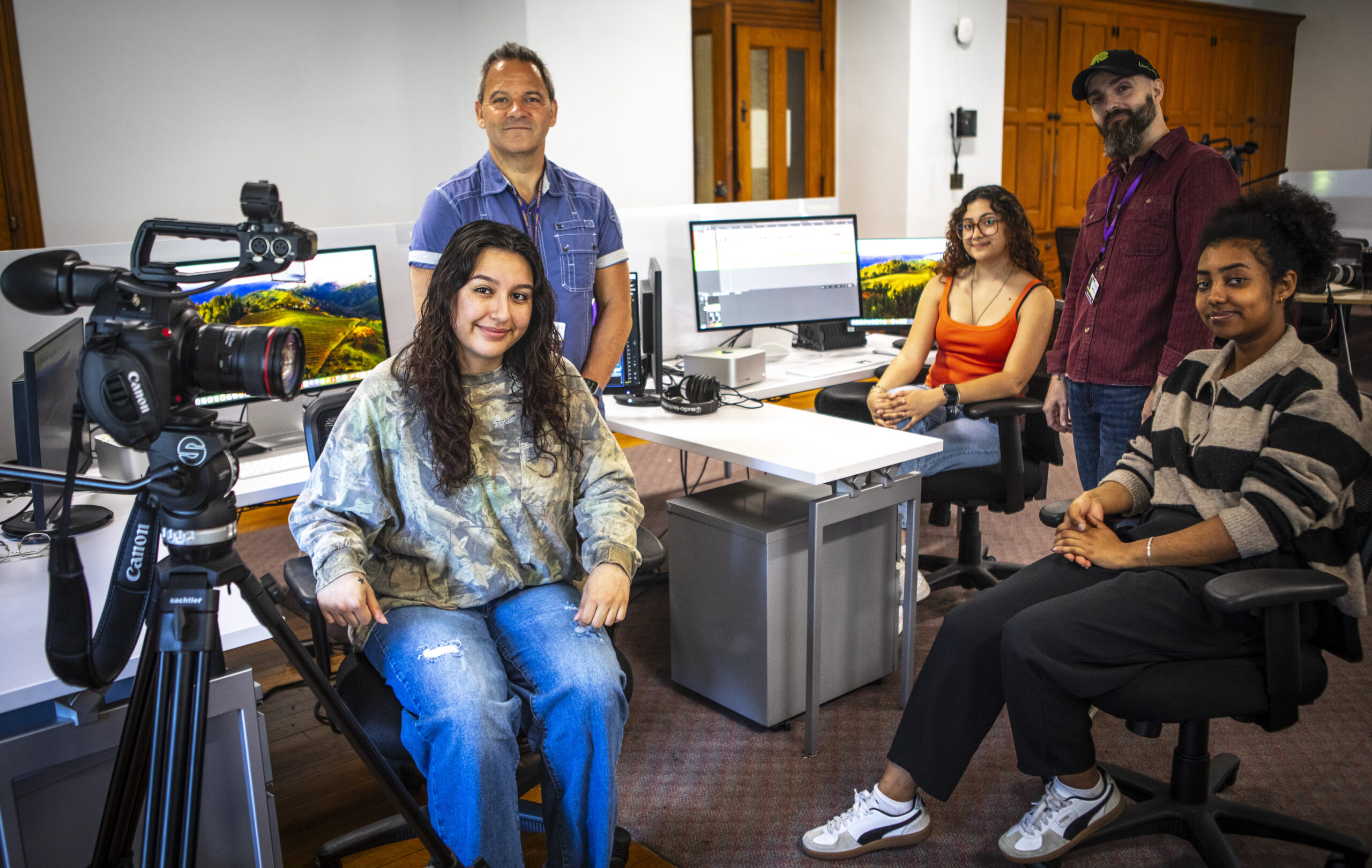
As the spring semester at Trinity Washington University came to a close, the core staff of the Trinity Times gathered for the second-season finale of their podcast, Enlightened Exchanges, to reflect on the state of journalism and their role in it.
The academic year began under intense political scrutiny as the U.S. presidential election approached, with several key developments, including former Vice President Kamala Harris’ nomination by the Democratic Party, dominating public discourse. Throughout the fall, Trinity Times student journalists reported extensively on the shifting political climate.
Articles such as “‘Democracy on the Ballot’ Symposium Inspires Students to Shape the Nation’s Future” and “Migrant Crisis Motivates Voters in 2024 Election” set the tone for what student journalism would look like under the incoming Trump administration.
Now, as the administration passes its first 100 days in office, a wave of executive orders has left multiple communities vulnerable — and student journalists are feeling the impact. Increasing threats to press freedom have reshaped how student media organizations operate on campuses nationwide.
In early April, a coalition of national student journalism organizations issued a rare joint “Student Media Alert,” warning of escalating threats to student speech tied to recent immigration enforcement actions on campuses.
The alert was released by the Associated Collegiate Press, Journalism Education Association, College Media Association, National Scholastic Press Association, Quill and Scroll, and the Student Press Law Center — all independent nonprofit groups supporting student journalism.
The warning came after Tufts University international student Rumeysa Ozturk was detained by federal authorities and had her visa revoked, reportedly due to opinions expressed in a student newspaper op-ed. The incident drew widespread condemnation from journalism and free speech advocates who raised alarms about its chilling effect on student media.
In response, the alert encouraged student journalists and media leaders to revisit their editorial policies — particularly regarding takedown requests and the use of anonymous sources when covering individuals whose immigration status may make them vulnerable.
“At this moment, it is essential to hear from those most impacted by current U.S. policies,” the alert stated. “It is our duty as journalists to seek them out. Find the balance required to tell the most accurate story you can while minimizing harm.”
Mike Hiestand, senior legal counsel at the Student Press Law Center, highlighted the gravity of the moment.
“I have been working at the Student Press Law Center for more than three decades, and I am now warning student journalists about things I have never had to tell them before,” Hiestand said in a prepared statement. “Student speech that is, or should be, fully protected by the law is now being weaponized by the U.S. government, and student media must adapt to continue to fully report on their communities.”
The alert also provided legal and editorial guidance to help student journalists manage these new challenges while remaining true to their mission.
Despite growing concerns, adjunct journalism professor Joshua Romney emphasized the crucial role student news organizations play amid increasing political attacks.
“I think it’s hard to teach generations of students about the importance of democracy and free speech and rights, and then have that suppressed, you know?” Romney said. “So, I’m very glad to see that Trinity has started back up Trinity Times, because I think it’s a huge benefit. It’s that hyper-local coverage of stories that are important to the students.”
Students majoring in Trinity Washington University’s journalism and media studies program actively develop their reporting, writing, and interviewing skills. Through work with Trinity Times and the Enlightened Exchanges podcast, they enjoy editorial independence — a stark contrast to the restrictions currently facing many journalists in the broader media landscape under the Trump administration.
Editorial independence refers to journalists’ ability to report freely without interference from political or institutional forces. That independence is increasingly under threat. In February, the White House broke a 111-year tradition by giving itself the authority to select media outlets that cover the presidency, contributing to public mistrust in the press.
“When I began working here at Trinity and they decided to relaunch Trinity Times [in early 2023], the administration here assured me that Trinity Times would be editorially independent,” said Chaz Muth, assistant professor of journalism and director of Trinity’s multimedia newsroom.
But even with administrative support at Trinity, the broader landscape for student journalism remains precarious. Universities across the country are grappling with censorship and administrative pressure. At the University of Texas, for instance, the editor of the student newspaper was reportedly fired after covering pro-Palestinian encampments on campus. The remaining staff went on strike and later resigned, eventually launching an independent newspaper with the help of the Society of Professional Journalists.
“Students are massively asking to have their names taken down from articles,” said Genesis Bu-Chinchilla, a student journalist with Trinity Times and Enlightened Exchanges. “There are sources wanting to be anonymous and students wanting entire stories to be removed. And I think there’s just mass fear going around everywhere around the country right now.”
Despite this atmosphere of fear and uncertainty, student journalists are showing resilience.
“At the same time these challenges are happening, I think there’s also a lot of pushback and I appreciate that people, journalists, and broadcasters are not backing down easily,” said Anette Perez, also a student reporter with Trinity Times and Enlightened Exchanges.
In a media landscape marked by distrust, consolidation, and censorship, student-run publications like Trinity Times stand among strongholds of independent reporting.
This strength comes from action as much as belief, Romney said.
“You don’t learn this stuff any other way than getting out and doing it,” he said, describing the hands-on culture of the Trinity Times newsroom, where journalistic values are put into practice every day.
From covering campus issues to national debates, the student reporting remains anchored in accuracy, courage, and public accountability, Romney said.
Still, the challenges are real. During the podcast discussion, staff reflected on the pressures they face — from institutional censorship to immigration policy impacts on international students.
“It’s not easy to continue on with a story that you know people don’t want you to continue to work on,” Muth said, referencing the tension between journalistic integrity and institutional resistance. Yet Trinity Times has remained steadfast in its editorial mission, fostering a newsroom culture committed to responsible, independent storytelling.
The work produced through Trinity Times and Enlightened Exchanges goes beyond coursework — it represents a commitment to journalism’s essential purpose in a changing world.
“I honestly believe journalism is going to survive, and it’s going to survive because it has to in order for democracy to survive,” Muth told the staff.
In that spirit, Trinity student journalists aren’t just preparing for careers — they’re already shaping journalism’s future, story by story, with clarity, conviction and care.