By Anette Perez
Trinity Times Correspondent
In an era dominated by political division and human demonization, students, alumni, faculty, staff, national scholars and advocacy leaders gathered at Trinity Washington University to examine how the new papacy of Pope Leo XIV blends Catholic teaching and social justice.
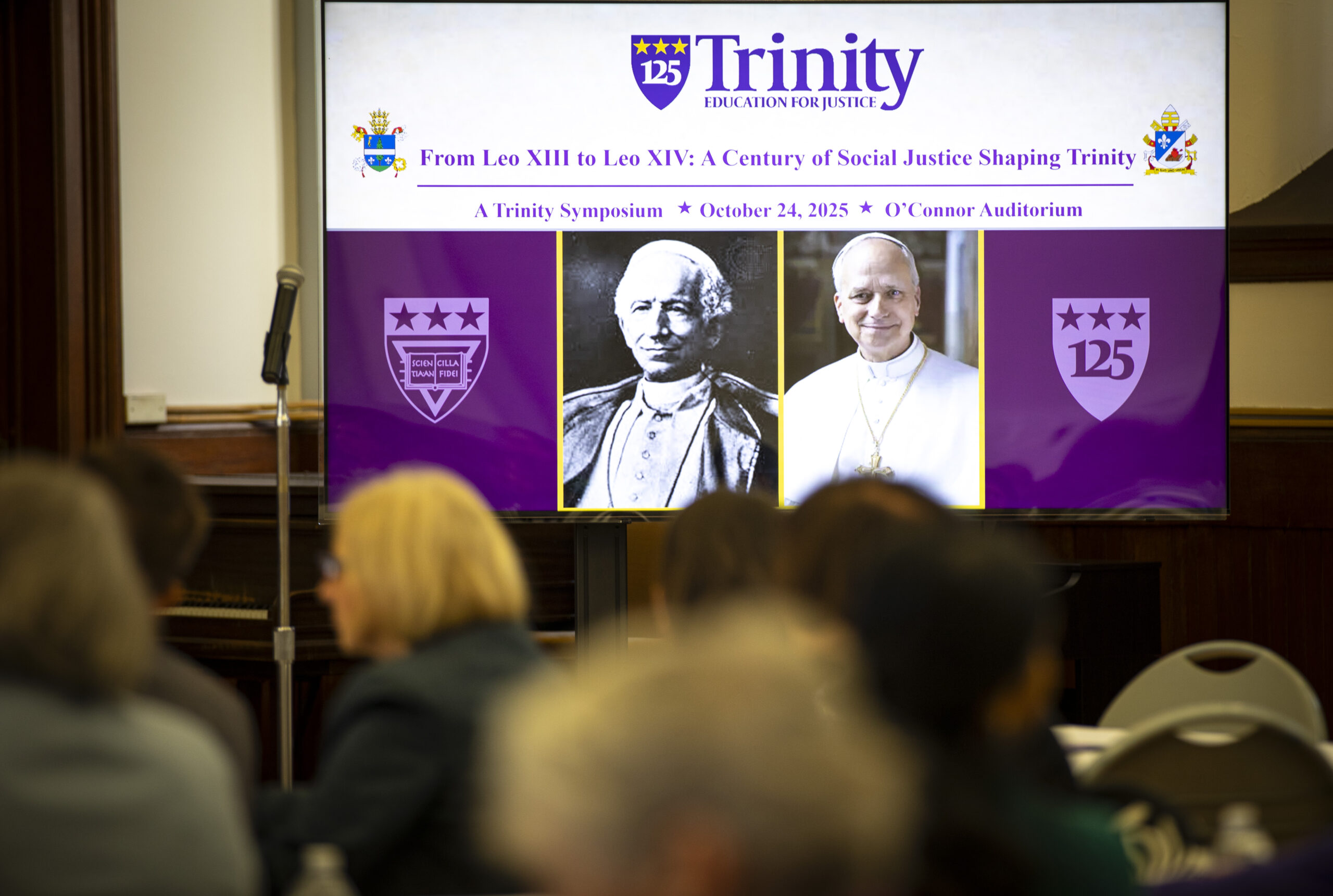
Trinity hosted an all-day symposium Oct. 24 titled “From Leo XIII to Leo XIV: A Century of Social Justice Shaping Trinity,” exploring how Catholic social teaching addresses modern issues.
“I look at this year as an excavation of my hope, because this year is bringing challenges at every turn,” said Krisanne Vaillancourt Murphy of the Catholic Mobilizing Network during one of the panel discussions. “But I’m encouraged by the young people and their wisdom that is seeking justice.”
Murphy referred to Pope Leo XIV’s message in response to actions taken by the Trump administration, including aggressive support of executions, immigration raids, detentions of ethnic minorities and the rollback of programs serving refugees and the poor.
The symposium highlighted Trinity’s core mission of social justice and how the new papacy is emphasizing that commitment in the face of what it views as violations of human dignity.
“This is a wonderful opportunity to come together to discuss one of Trinity’s most essential core mission values and how social justice affects all that we do today,” Trinity President Patricia McGuire said in her invitation to the campus community.
The event also marked Trinity’s 125-year commitment to social justice education. To celebrate the milestone, McGuire opened the symposium with remarks on Pope Leo XIII’s influence on Trinity.
Founded in 1897 by the Sisters of Notre Dame de Namur, Trinity was shaped by Pope Leo XIII’s 1891 encyclical Rerum Novarum, which laid the foundation for modern Catholic social teaching. His call for justice for underserved populations became a guiding principle for Trinity’s mission to educate women committed to leadership and service.
Father Stephen Thorne, distinguished professor of education at Trinity, moderated a panel featuring Murphy, Ralph McCloud of NETWORK, and Kim Daniels from Georgetown’s Initiative on Catholic Social Thought and Public Life. The panel discussed strategies for combating hopelessness in social justice work today.
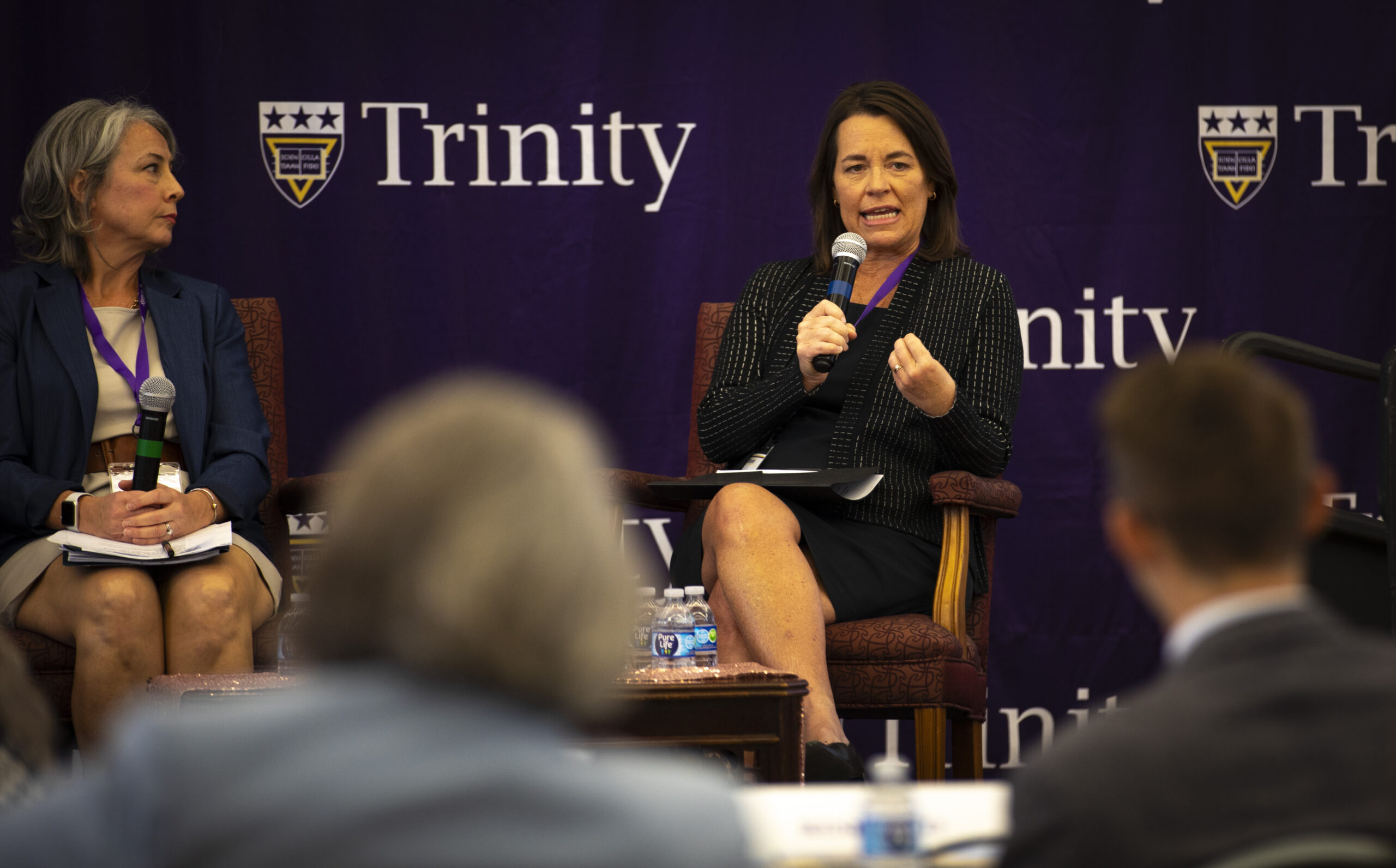
The conversation also examined Pope Leo XIV’s application of Catholic social teaching. Thorne referenced an instance in which the pope said, “Someone who says, ‘I’m against abortion, but I’m in favor of the death penalty,’ is not really pro-life,” prompting discussion about the pope’s stance.
McCloud praised Pope Leo XIV, noting how the pope’s international experiences shaped his understanding that human dignity is central to Catholic social teaching.
“That sounds like Pope Leo XIV understands Catholic social teaching,” McCloud said, drawing laughter and applause from the audience.
Amid the discussion, House Speaker Emerita Nancy Pelosi, a member of Trinity’s Class of 1962, addressed the audience, connecting her faith to social justice and Trinity’s mission.
Pelosi expressed what faith means to her and the excitement she felt upon learning the next pope would be Pope Leo XIV, linking her astonishment to Pope Leo XIII’s Rerum Novarum.
“I believe as a Catholic that Christ enabled us to participate in his divinity, and therefore, there’s a spark of divinity in every person who is to be respected,” she said. “Whether it’s a homeless person on the street, an immigrant coming across the border, whatever it is. In fact, in each of us, we have a responsibility to act upon our spark of divinity.”
Pelosi said believing in the goodness of others provides hope. She encouraged the audience to let compassion guide them and credited McGuire as “the most remarkable personification of all the goodness that we would hope that all of us have in our hearts.”
Later, Christopher White, author of Pope Leo XIV: Inside the Conclave and the Dawn of a New Papacy, joined Trinity Assistant Professor of Religious Studies Jeannine Marino on stage. White offered an inside look at the conclave during the election of Pope Leo XIV and discussed the new pope’s vision for the future of the Catholic Church.
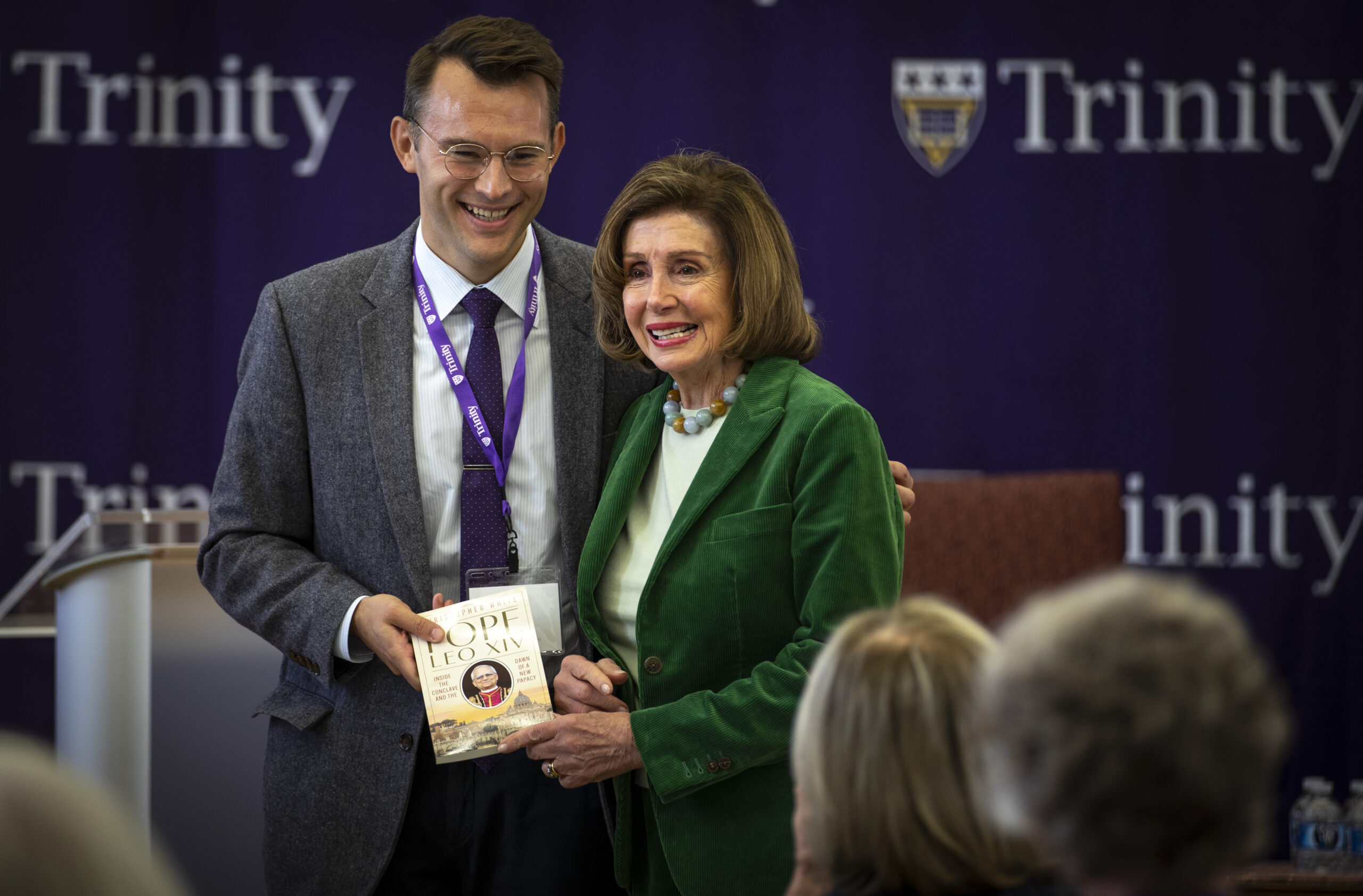
White said that in these early days, it is clear that Pope Leo XIV has grounded himself in Catholic social teaching, while Pelosi expressed appreciation for Trinity’s education on both Popes Leo XIII and XIV.
Amelia Uelmen of the Georgetown University Law Center followed with a talk linking Pope Leo XIII’s compassion for the poor to today’s discussions on diversity, equity and inclusion (DEI). She cited writings from both Pope Leo XIII and Pope Francis, emphasizing that a society’s worth depends on how it treats the weak and marginalized.
Uelmen also addressed a March 2025 controversy in which the interim U.S. attorney for the District of Columbia sent a letter to Georgetown University Law Center criticizing its DEI curriculum and threatening to deny federal internships or jobs to students from schools that continue DEI programs.
“It is not the job of a federal prosecutor to be directing what a university can teach or how to teach it,” she said. “The Supreme Court has continually affirmed that among the freedoms central to a university’s First Amendment rights are its abilities to determine on academic grounds who may teach, what to teach, and how to teach it.”
Uelmen and Marino agreed that DEI is not optional but rooted in Gospel principles and Catholic social teaching. McGuire concluded the session by affirming Trinity’s commitment to both principles.
“When you talk about DEI, Trinity is DEI,” she said. “We live it every day, and we don’t have special programs — it’s what we do.”
The symposium’s final panel focused on the immigration crisis through the lens of Catholic social teaching.
It featured Trinity alumna and TheDream.US director Rosa Reyes, Todd Scribner, assistant director at the U.S. Conference of Catholic Bishops, and Celia Rivas, immigration services coordinator at Catholic Charities D.C. Current Trinity students junior Belky Lemus Alvarado and senior Sayuri Cervantes Perez also participated.
Scribner detailed how recent aggressive federal immigration policies have overwhelmed advocacy groups, dismantled protections such as Temporary Protected Status (TPS) and asylum rights, and expanded enforcement and detention.
He emphasized the Catholic Church’s duty to care for migrants at both moral and spiritual levels, beyond political advocacy. He concluded that, in the face of an anti-immigrant climate, the Church must demonstrate mercy and faithfully live out Christ’s command to “welcome the stranger.”
Rivas offered a humanitarian perspective on the severe challenges immigrants face under the Trump administration, focusing on their lived experiences, trauma and the importance of holistic support. She emphasized that immigrants’ well-being cannot be reduced to legal status alone.
For students, the symposium provided a chance to engage more deeply with Trinity’s commitment to Catholic social teaching, prompting senior Flor Meraz to tell Trinity Times the event resonated with her personal definition of social justice.
“To me, social justice is standing up for those who do not have a voice and are often ignored or misunderstood,” Meraz said. She left the symposium inspired to share what she learned with her peers and mentees, aiming to create a space where they feel seen, heard and empowered.
“We live social justice,” McGuire said, referring to Trinity’s mission, “in the work we do, who we admit, in the way we do financial aid, in the way we do student support, and so forth.”