By Tanzania Kennedy
Trinity Times Correspondent
When Trinity nursing student Didra Johnson enrolled at Trinity Washington University, she knew women of color were significantly underrepresented in science, technology, engineering and mathematics. That knowledge, she said, only made her more determined to help break those statistics.
According to the National Science Foundation, women make up just 17.6% of the STEM workforce nationwide. A 2024 NSF report shows that in 2021, the STEM workforce was one-third women, but representation varied widely by race: Hispanic workers made up about 15%, Black workers 9% and Asian workers 10%.
The lack of representation has consequences. Women of color in STEM often encounter imposter syndrome, mental health challenges and feelings of isolation – hurdles that become even more difficult when they rarely see themselves reflected in classrooms, labs or the workplace.
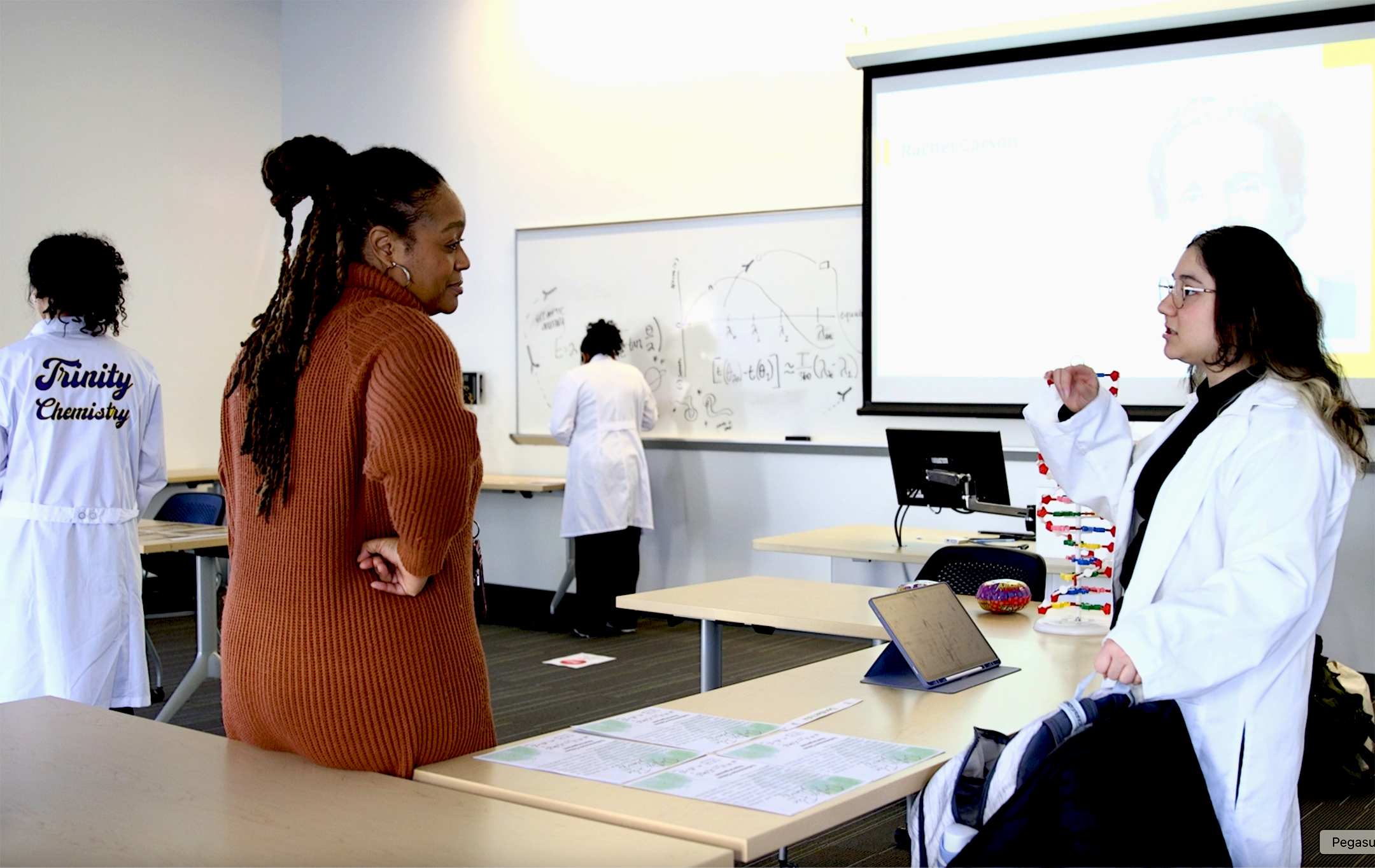
At Trinity, however, faculty, students and student-led organizations work to counter those obstacles by building community, mentorship and sisterhood. That support system, students say, helps women of color persist in STEM majors and feel prepared to thrive in the field.
Biology professor Taylor McFadden said representation plays a major role in helping students imagine themselves in scientific careers. Strong mentorship, she said, is rooted in “validation, advocacy, insight and representation.”
One of the students working to build that culture of support is Lorena Mendoza, a biology and chemistry double major who serves as president of Ladies F.I.R.S.T. – short for Ladies Fierce in Research, Science, and Technology, a student organization focused on supporting women in STEM. Mendoza said the group’s mission is to create a space where women feel uplifted, encouraged and connected.
She described the club’s sense of sisterhood as a commitment to showing up for others – not only for members, but for “other STEM students who might not even be in the club.” That can mean “encouraging them to apply for internships they may not have known about,” recommending students to professors, offering tutoring even when not officially tutors, and reviewing internship or graduate school applications.
Data shows just how crucial that support can be. At the bachelor’s degree level, the gaps are stark. According to the National Center for Education Statistics, in 2015–16 only 12% of the degrees Black students earned were in STEM, compared with 14% for American Indian/Alaska Native students and 15% for Hispanic students. In contrast, 33% of degrees earned by Asian students and 18% earned by white students were in STEM fields. And although women earned more bachelor’s degrees overall that year, they received only 36% of STEM degrees.
The gaps widen further in graduate education. A 2023 analysis by the Education Trust found that STEM doctoral degree attainment among Black women decreased from 1.3% of all STEM doctorates in 2010 to 1.1% in 2019. Latina women saw only slight growth, from 1.4% to 1.7%, during the same period. A 2024 report from the Association of American Medical Colleges notes that Black women represent less than 7% of doctoral candidates in science and engineering and less than 9% of the STEM workforce.
For Johnson, overcoming those barriers takes resilience – and relying on Trinity’s network of support. She encourages other women of color in STEM to “push through,” even in moments of self-doubt. Tutors, classmates and faculty have helped her along the way.
“It is so rewarding to know that something challenged you,” Johnson said, “and you push straight ahead.”
At Trinity, that perseverance is strengthened by a community rooted in sisterhood. Faculty mentors, student organizations and peers work together to create an environment where women of color in STEM can ask questions, build confidence and envision themselves as future scientists, engineers and health professionals.