
By Angela Young
Trinity Times Correspondent
Main Hall at Trinity Washington University is an iconic District of Columbia structure that symbolizes the historic and architectural splendor of the Catholic college, but what makes the building a standout also makes it a maintenance struggle.
When the Sisters of Notre Dame de Namur broke ground on Main Hall in 1897, their vision was to establish then Trinity College with a grey stone structure with a Spanish style red-barrel roof that embodied the beauty of their religious charism.
More than 100 years later the building continues to make a statement of grandeur, but it’s an enormous structure of its era that wasn’t originally constructed with 21st century facilities.
Though Trinity students appreciate the architectural splendor of parts of Main Hall, some do have complaints about the unpredictable heating system, lack of central air conditioning, wobbly flooring in parts of the building, and shabby stained furniture in some of the common areas.
Some students who reside in Trinity campus housing on the fourth floor of Main Hall – who spoke to Trinity Times on the condition of remaining anonymous – complained about a gaping hole in the ceiling of the 15-room student residence hall, inoperable bathrooms, badly stained carpet, and thick dust along the baseboards, some of which are broken.
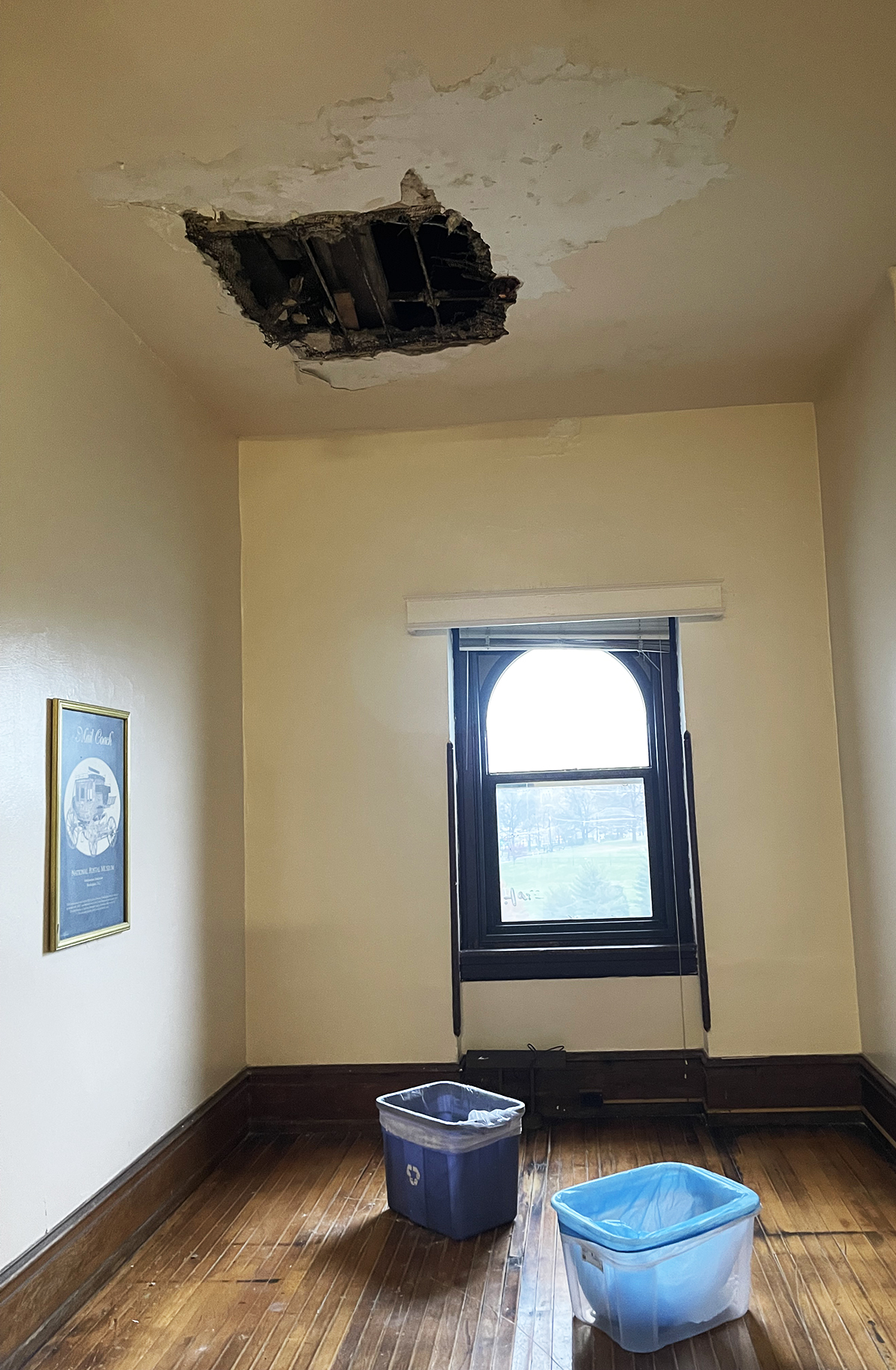
Trinity President Patricia McGuire acknowledged there are maintenance challenges in Main Hall and in other buildings throughout the campus and said it’s an ongoing crusade to keep up with the repairs and modernization of very old structures.
However, McGuire was unaware of some of the more egregious conditions in the Main Hall campus housing area, such as the hole in the ceiling, inoperable bathrooms, stained carpet, and dirty-broken baseboards, until Trinity Times presented her with recent photos of the problem areas.
“I am copying personnel responsible for the condition of our facilities and residence halls and asking them to take appropriate actions immediately to address the maintenance and repair issues that I see in the photos,” McGuire told the Trinity Times April 18, 2023.
“Regarding your question about whether it is unreasonable for students to raise these issues, it is never a problem for students to raise complaints and various issues,” she said. “We need to hear from students so that we know what’s going on.”
The university president said it is not acceptable for such conditions to be in student residential areas and she is asking the facilities team to take immediate corrective action.

“Our beautiful historic buildings always require a great deal of maintenance, much of which is work that takes place away from the public view – boilers and work on the steam heat system, electrical, plumbing, roofs and structural repairs, elevators and more,” McGuire said. “We work on upgrading Main Hall all of the time, but the building is far too big to contemplate a one-time renovation. The cost of full renovation of Main Hall would top $200 million easily.”
About the heating system in Main Hall, she said that is a project that will not be happening anytime soon.
“Replacing the steam heat system in Main Hall would be a capital improvement that will probably easily cost $75 million or more to replace just the system with a modern HVAC system requiring all new machinery, piping, vents, etc.,” McGuire said. “This kind of renovation requires breaking into walls and ceilings, so the work is not just the machinery and pipes but structural as well.”
The university budgets nearly $5 million annually for campus upkeep, which includes utilities like water, electrical and natural gas, along with the repair and maintenance costs, personnel for housekeeping, grounds, engineering, and facilities management through a contract with Aramark, she said.
In addition to the annual operating budget, the university schedules capital projects that can add up to several million dollars annually, depending upon the undertakings and the amount of donor support contributed to Trinity, McGuire said.
“For example, several summers ago we replaced the roofs on (Sister Helen Sheehan) Library, Cuvilly (Hall) and Kerby (Hall), and that was at a cost of more than $1 million,” she said. “We renovated all of the bathrooms in Cuvilly at a cost of about $500,000. Last year, with some support from a donor, we installed air conditioning in Notre Dame Chapel at a cost of about $1.5 million.”
Climate control in Main Hall garners some of the biggest complaints about the building, with an old radiator heating system that has two functions, on or off, and in the colder winter months parts of the building are either bitter cold or sweltering.
“I keep summer clothes in my office for the winter days when the heat is on full blast,” said Elizabeth Childs, an English professor at Trinity, whose office is in Main Hall, as are many of the classes she teaches.
Though Childs experiences the challenges of being in a building daily that was completed in 1910, she said she loves working in Main Hall.
“The marble corridor, the high ceilings, the detailed woodwork, the wide staircases, the light pouring into the well from the skylight,” she said, “all evokes the history and ongoing story of Trinity, while the people walking by are a firm tether to the present day.”
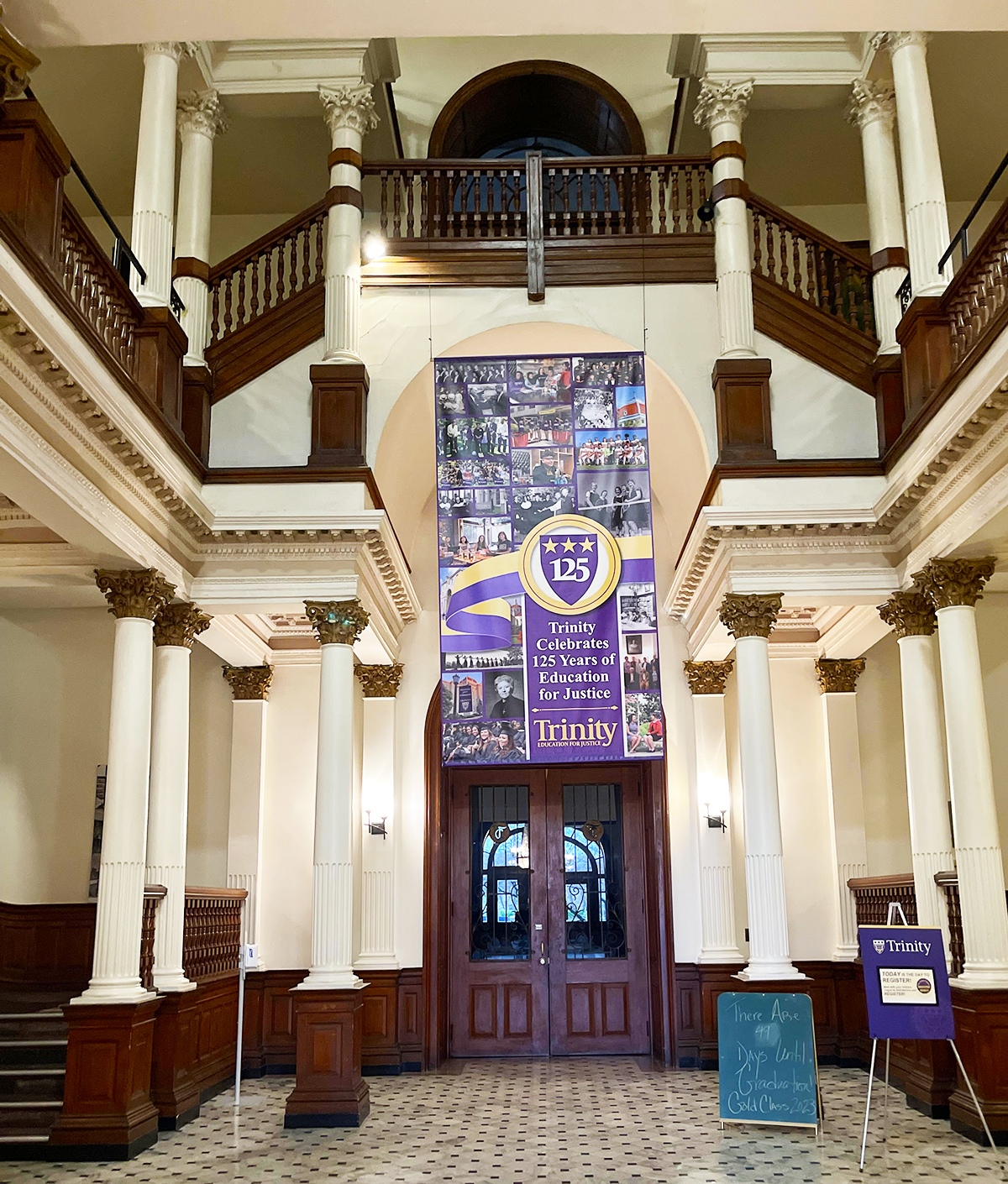
Child’s favorite features about Main Hall are the “secret” staircases.
“On a whim I once went down a staircase behind a door I had never seen anyone use and next thing I knew, I was lost in the sub-basement,” she said. “It was an unexpected adventure!”
Most the campus’s administrative offices, numerous faculty offices, classrooms, a chapel, and O’Connor Auditorium are located in the 225,000-square-foot Main Hall, which also houses senior undergraduate students and graduate students in the residential wing on the fourth floor.
Every ten years, Trinity must submit a Campus Master Plan to the District of Columbia, listing the building and maintenance priorities for the university.
The top priority in the university’s current master plan is the renovation of Alumnae Hall and has engaged two different teams of architects and contractors to evaluate the likely scope of renovation, and both times the teams came back with an estimated price tag of about $50 million.
That cost would include a completely new HVAC system, replacing/modernizing the kitchen and servery, upgrading elevators and plumbing, and renovation of the residential rooms, McGuire said.
“Currently, due to the pandemic, there is a severe labor shortage and equally difficult supply chain issues that have driven up the costs of construction rapidly,” she said. “We estimate the cost of the Alumnae Hall project could reach $60 million by the time we start the work. We have raised close to $10 million in our current capital campaign for that project and are talking with donors all the time.”
With an understanding that it may take years to fully address some of the deficits in Main Hall, McGuire said parts of the building remain unused.
“We are always looking at ways to upgrade various spaces to improve functionality and comfort,” she said, “and we also always put a priority on life safety and accessibility.”
The women religious who founded Trinity had a grand vision for a great women’s college, McGuire said, “and we take our stewardship of their vision quite seriously.

“When they broke ground for Main Hall (in 1897), they could not have imagined what modern facilities would look like or require,” she said. “In fact, the original plan for Main Hall was quite different. The original parts of the building… did not have electricity or an elevator. By the time the building was finished in 1910, electricity had become a normal feature of new buildings.”
McGuire is urging students to contact Trinity administration officials – such as the vice president of student affairs and the director of residence life – when they encounter a maintenance issue on campus.”Work orders come in constantly,” she said, “and the facilities personnel should be addressing the repairs constantly.”